
Ground balls can quickly change the momentum of a girls’ lacrosse game.
Winning the ball is only the first step. Players also need to scoop it cleanly, protect their stick, handle pressure, and make the next pass to keep possession.
That means ground ball work should progress beyond simply running to a stationary ball.
A good progression starts with clean pickups, then introduces pressure and competition, and eventually requires players to win the ball and make a useful outlet pass.
Here are five girls’ lacrosse ground ball drills that can help build those skills.
1. 5-Yard Scoop Drill to Improve Ground Ball Pickups
Start with the 5-Yard Scoop Drill to Improve Ground Ball Pickups.
This is a good starting point because players can focus on the mechanics of getting to the ball and scooping it cleanly before adding defensive pressure.
Set up two cones approximately five yards apart with players working in a line.
A player moves toward the loose ball, gets her stick underneath it, scoops through the ball, and accelerates away.
The important part is what happens immediately after the pickup.
Players shouldn't scoop the ball and stop.
Have them:
Get low as they approach the ball
Scoop through rather than stabbing at it
Keep their stick protected after the pickup
Accelerate away from the ground ball
Get their eyes up once they have possession
Coaching Cue
“Scoop and go.”
The goal is to make moving with the ball part of the ground ball habit.
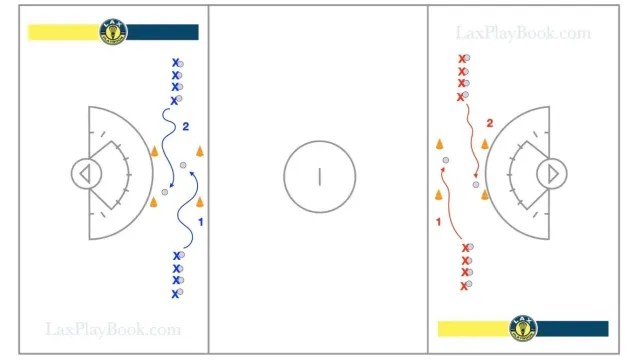
2. 2 on 1 Ground Balls
Once players are comfortable picking up uncontested ground balls, introduce pressure with 2 on 1 Ground Balls.
Now the player isn't simply trying to scoop the ball.
She has to win possession while dealing with an opponent.
This changes the decision-making.
The two attacking players should work together to gain possession while the defender applies pressure.
Focus on the player closest to the ball getting there first while the second player provides support.
Once possession is gained, the player with the ball should protect her stick and look for the next pass rather than holding onto it unnecessarily.
Coaching Cues
“Win it. Protect it. Move it.”
This is an important progression for young players because a successful ground ball doesn't always mean the play is finished.
The team needs to turn that ground ball into possession.
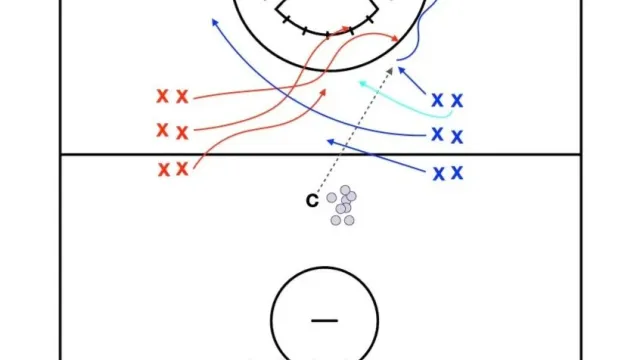
3. 2v2 Circle Ground Ball Drill
Next, increase the pressure with the 2v2 Circle Ground Ball Drill.
With two players on each team competing for the ground ball, players have to recognize space, communicate, and work together to gain possession.
This is where ground balls start becoming more game-like.
Encourage players to think about more than just the ball.
The player closest to the ball should attack it.
The teammate should provide an outlet or support position.
Once someone wins the ball, the team should immediately look to secure possession.
Pay attention to players who dive toward the ball without considering what happens next.
Teach them to anticipate the play before they even scoop.
Coaching Cue
“Who's got ball? Who's got help?”
This encourages players to communicate before the ground ball becomes a scramble.
4. 5v4 Ground Ball Challenge
Now increase the competition with the 5v4 Ground Ball Challenge.
This drill introduces more players and more pressure around the ground ball, making it useful for teaching players how to compete when the ball isn't cleanly won on the first attempt.
The goal is not simply to scoop the ball.
Players need to fight for possession, support their teammates, and make decisions once the ball is secured.
This is where coaches can start emphasizing the transition from ground ball to possession.
When your team wins the ball:
Secure it.
Protect the stick.
Create an outlet.
Move the ball away from pressure.
Continue playing.
Don't let players assume that winning the ground ball automatically means the team has possession.
The next few seconds matter just as much.
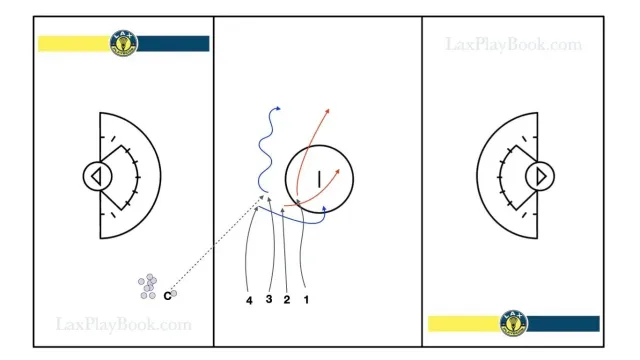
5. Full Field 2 Balls 4 Middies Clearing Drill
Finish the progression with the Full Field 2 Balls 4 Middies Clearing Drill.
This brings the ground ball into a larger field situation where players have to connect the pickup with the next phase of play.
The objective is no longer simply to win a ground ball.
Players need to recognize where the outlet is and move the ball up the field.
This is where you can reinforce one of the most important ground ball habits:
Ground ball → move the ball.
Your existing coaching material emphasizes this exact concept, including picking up the loose ball and getting it out of the stick quickly.
Have players look up immediately after the pickup.
Can they find a teammate?
Is there an open passing lane?
Should they carry the ball?
Is pressure coming?
The faster players can answer those questions, the more useful their ground ball becomes.
What to Watch for When Coaching Ground Balls
Players Reach Instead of Moving Their Feet
Encourage players to get their body behind the stick and move through the ball.
Players Stop After the Scoop
A ground ball isn't finished when the ball enters the pocket.
Players should immediately protect, accelerate, and look for their next option.
Players Keep Their Heads Down
Once the ball is secure, players should get their eyes up.
This is especially important when moving into the outlet portion of the drill.
Players Try to Do Everything Alone
The player who wins the ground ball doesn't always need to carry it.
Teach teammates to provide support and create an easy outlet.
Players Don't Communicate
Ground balls are chaotic.
Simple communication can help teammates know who is attacking the ball and who is providing support.
Build From the Pickup to the Pass
The best way to teach ground balls is to build the skill progressively.
Start with clean pickups.
Then add a defender.
Increase the competition.
Add teammates.
Finally, connect the ground ball to the next pass and the transition up the field.
The progression is:
Scoop → Protect → Compete → Possess → Outlet.
When players learn to think beyond the scoop, ground balls become more than an individual skill.
They become a way for your team to win possession and immediately turn that possession into offense.

Discussion
Comments (0)
No comments yet.
Log in with an active subscription to comment.
Log in