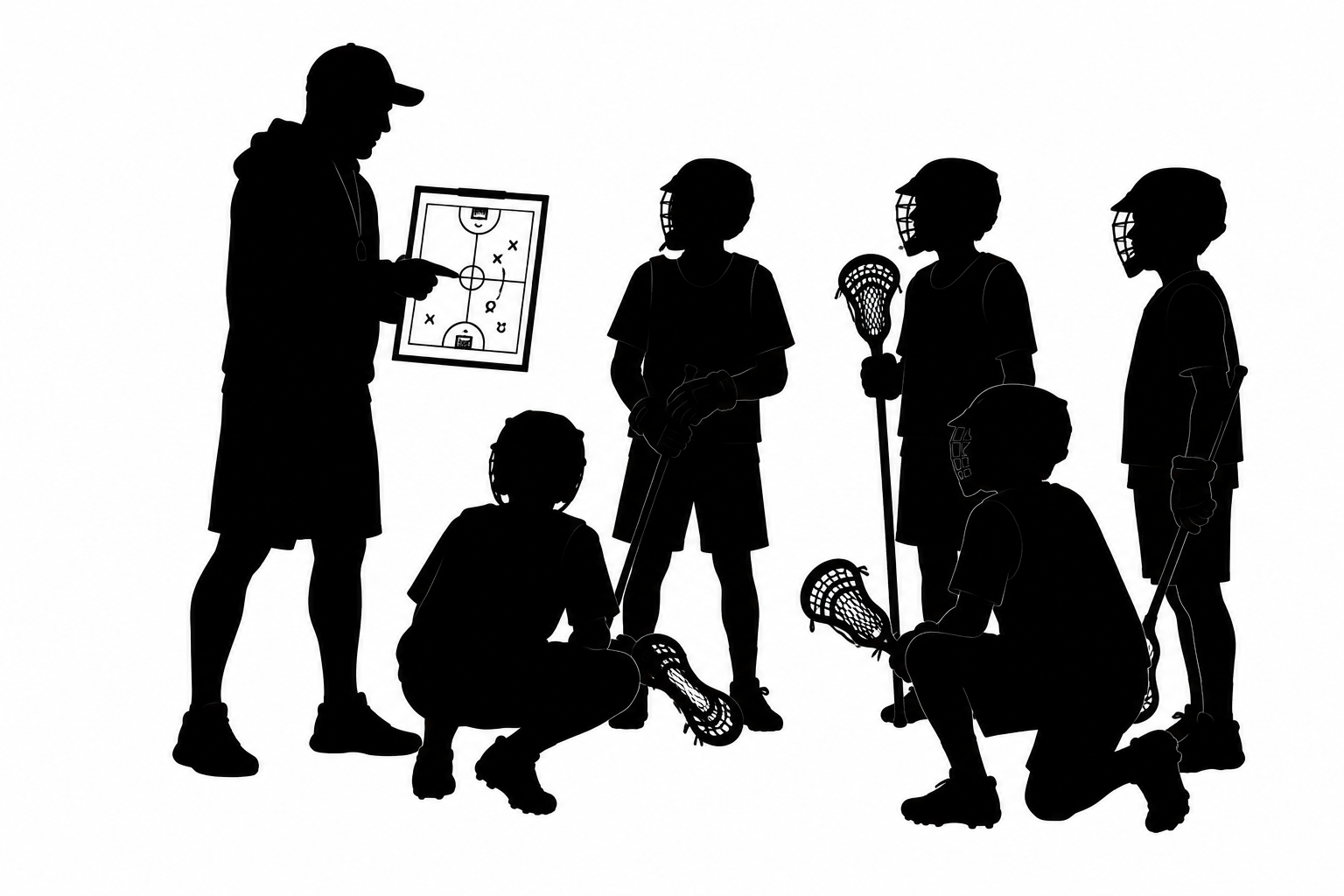
Running practice with only 8–12 players can actually create a useful advantage: players get more touches, more repetitions, and more opportunities to make decisions.
The challenge is keeping everyone active.
With a small roster, long lines and complicated stations can quickly turn into standing-around time. Instead, build the practice around small-sided drills, continuous movement, and activities that can be adjusted for different ability levels.
This 60-minute youth lacrosse practice plan uses drills from both the men’s and women’s LaxPlayBook libraries and is designed around 8–12 players, limited equipment, and mixed skill levels.
What You Need
You can run this practice with:
8–12 players
Lacrosse sticks
6–10 lacrosse balls
6–10 cones
1 goal
Goalkeeper equipment if you have a goalie
A small portion of the field
You do not need multiple goals or a full team to keep the session moving.
The key is to avoid drills that require players to wait for long turns.
0:00–0:08 — Warm-Up and Stick Skills
Start with a dynamic warm-up that gets players moving while immediately putting a stick in their hands.
Instead of separating conditioning from stick work, combine the two.
Players can work through:
Jogging and dynamic movements
Cradling right and left handed
Changing direction
Ground ball pickups
Short passing with a partner
Quick changes of hand
For younger or newer players, keep the distances short and focus on control.
For more advanced players, add movement before the catch or require the non-dominant hand.
The goal is to get everyone moving and touching a ball within the first few minutes.
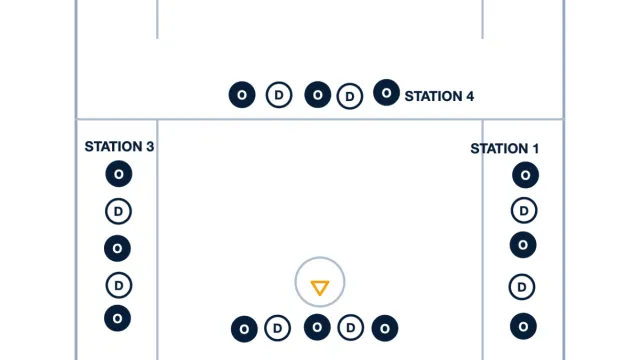
0:08–0:18 — Triangle Passing Drill
Use the Triangle Passing Drill to build passing, catching, communication, and movement.
The drill works particularly well with a small roster because you can create multiple triangles and keep everyone involved. The men's version is designed to develop passing accuracy, stickwork, off-ball movement, communication, and continuous motion.
Set up players in groups of three.
Players pass around the triangle while continuously moving to the next position.
Start simple
Have players:
Pass to the next player.
Follow their pass.
Catch with two hands.
Move the ball quickly.
Once they are comfortable, progress to:
One-handed catches
Weak-hand passing
Faster passes
Pass-and-cut movement
Communication before receiving
For beginners
Make the triangle smaller and allow players to catch with two hands.
For advanced players
Increase the distance or require players to use their non-dominant hand.
Coaching cue:
“Pass, move, communicate.”
0:18–0:28 — 5-Yard Scoop Drill
Move into ground balls with the 5-Yard Scoop Drill to Improve Ground Ball Pickups in Lacrosse.
This men's drill is designed to teach players to pick up the ball while moving rather than stopping completely over the ball.
Place several balls on the ground and have players attack them at speed.
The basic progression is:
Run → Scoop → Cradle → Accelerate
Don't let players turn the drill into a slow walk toward the ball.
Coaching points
Get low.
Run through the ball.
Scoop with two hands.
Protect the stick immediately.
Accelerate after the pickup.
With 8–12 players, create two lines or two small groups so players aren't waiting for a single repetition.
Add competition
For older or more experienced players, turn it into a race.
The player who scoops the ball first must carry it through a cone gate before the next player goes.
This adds urgency without requiring additional equipment.
0:28–0:38 — 2-on-1 Ground Balls
Next, introduce competition with the 2-on-1 Ground Balls drill.
This men's drill focuses on recovering a ground ball, communicating, using the extra player, and quickly moving the ball after possession is won.
Place two players on offense against one defender.
Roll out a ground ball and let the players compete for possession.
Once the offensive team wins the ball, they should immediately transition into a pass.
The teaching progression
Start with:
Win the ball → Protect it → Pass
Then progress to:
Win the ball → Protect it → Recognize pressure → Make a decision
For younger players, don't worry about complicated tactics.
The main lesson is:
Don't stop after winning the ground ball.
The next play starts immediately.
Mixed-ability adjustment
Pair a more experienced player with a developing player.
The more experienced player can be responsible for communication while the newer player focuses on the pickup and first pass.
This gives both players a specific job.
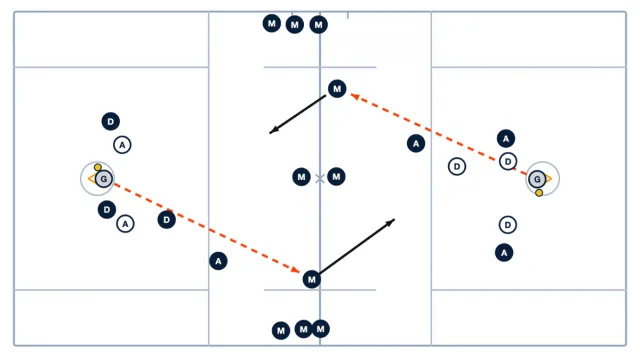
0:38–0:48 — Full-Field 2v1 Ground Ball Into a Fast Break
Now connect the individual skills to transition.
Use the Full Field 2v1 Ground Ball into a Fast Break.
This men's drill combines ground balls, transition, and fast-break decision-making.
With a small roster, you can make the field smaller if necessary.
Start with a ground ball and two offensive players competing against one defender.
Once possession is secured, the players immediately attack.
The ball carrier has two options:
Carry into space
Pass to the open teammate
Coaching points
Ask players:
“Where is the defender?”
“Where is the space?”
“Can you move the ball before the defender gets set?”
This introduces lacrosse decision-making without requiring a large team.
For younger players, give the offense more space.
For advanced players, allow the defender to apply full pressure immediately after the ground ball is won.
0:48–0:55 — 3v2 Scramble Drill
Finish the skill progression with a 3v2 Scramble Drill.
The men's version develops offensive spacing, passing, shooting, defensive communication, and transition awareness. LaxPlayBook also has variations that change where the 3v2 begins so players have to react rather than simply memorize a pattern.
With only 8–12 players, don't worry about running a traditional full-field version.
Use a smaller playing area and rotate players quickly.
Three attackers play against two defenders.
The offense's goal is to:
Spread out
Move the ball
Attack open space
Recognize the defender
Create a shot
The defense focuses on:
Communication
Staying between the ball and goal
Supporting teammates
Recovering after a slide
Small-roster rotation
After each rep:
Attackers become defenders.
Defenders rotate out.
New attackers enter.
Keep each repetition short so everyone gets multiple turns.
The goal isn't to run a perfect offensive set.
It's to make players see the field and make decisions.
0:55–1:00 — Scoop and Shoot
End with something competitive and fun.
Use Scoop and Shoot, a men's youth drill that combines ground balls, quick transitions, and shooting while keeping players active.
Place several balls around the shooting area.
Players scoop, accelerate, and finish with a shot.
You can turn it into a simple competition:
How many goals can the group score in two minutes?
Or divide the players into two teams and keep score.
For younger players, allow them to shoot closer to the goal.
For experienced players, require them to switch hands or shoot from different angles.
Ending with shooting gives players a fun final challenge while reinforcing the ground-ball skills they worked on earlier.
How to Adjust the Practice for 8 Players
With only eight players, avoid creating too many separate lines.
Use:
2v2 instead of 3v3
2v1 instead of larger transition drills
Two passing triangles
Shorter rotations
Smaller playing areas
The biggest priority is repetition.
If a player spends more time waiting than playing, change the setup.
How to Adjust for 12 Players
Twelve players give you enough numbers to create more competition.
For example:
Three groups of four for passing
Two ground-ball groups
3v2 transition rotations
3v3 small-sided games
You can also have players rotate between offense and defense instead of assigning permanent positions.
This keeps the practice moving and gives players experience in different situations.
How to Handle Mixed Skill Levels
One of the biggest challenges with youth practices is having players who are at completely different stages of development.
Avoid automatically separating them for the entire practice.
Instead, change the difficulty of the same drill.
For developing players
Give them:
Shorter passing distances
More time
Two-handed catches
Larger spaces
Passive defenders
For experienced players
Add:
Weak-hand requirements
More defensive pressure
Smaller spaces
Faster decisions
Time limits
One-touch passing
Everyone can work on the same fundamental skill while facing an appropriate challenge.
Keep Limited Equipment From Limiting the Practice
You don't need a different piece of equipment for every activity.
One goal is enough.
If you only have a few balls, use them strategically and keep players moving between repetitions.
Cones can mark:
Passing areas
Shooting spots
Starting lines
Defensive zones
Small-sided fields
You can also modify many drills to work without a goal.
For example, instead of finishing into a cage, players can score by carrying the ball through a cone gate or completing a pass to a designated target.
The 60-Minute Progression
The session follows a simple progression:
Warm up → Pass → Scoop → Compete → Transition → Play → Shoot
Each section builds on the previous one.
Players first work on controlling their sticks and moving their feet. Then they add passing, ground-ball competition, transition decisions, and finally game-like situations.
That progression is particularly useful with small rosters because every drill can involve the entire group.
The Main Goal: Keep Everyone Playing
A small roster doesn't require a complicated practice plan.
In fact, it gives you an opportunity to give every player more touches and more repetitions.
Keep the drills short. Keep the lines moving. Adjust the space and pressure based on ability.
Most importantly, give players opportunities to solve problems with the ball in their sticks.
For a youth team with 8–12 players, a productive 60-minute practice can be built around a handful of simple activities that progressively move from fundamentals to competition.
And when equipment is limited, creativity in the setup matters more than having more gear.
Discussion
Comments (0)
No comments yet.
Log in with an active subscription to comment.
Log in