
Uneven transition situations are an important part of lacrosse practice because they force players to recognize opportunities quickly.
A 2v1 can become a 3v2. A 3v2 can become a 4v3. Players have to look up, find the open player, communicate, and react to defensive slides while the situation is constantly changing.
Many college programs use full-field progression drills like this with large rosters. But high school and recreational teams often have fewer players, making a traditional full-field version difficult to run.
The 2v1 Build-Up adapts that concept for smaller rosters while keeping the pace high.
Setting Up the Drill
Start with a line of defensive players positioned off to the side in an alley.
This line can include your poles and some of your midfielders.
The remaining short-stick midfielders begin at the midfield line.
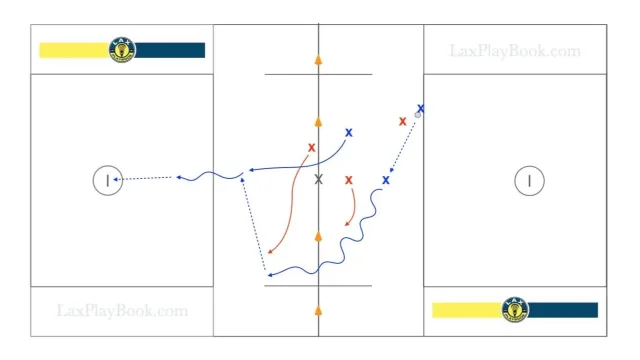
The first repetition starts with two offensive players sprinting down the field while one defender enters the play.
Now you have a 2v1.
The key is speed.
Each repetition should last only about 4-6 seconds.
Build the Progression
After the first 2v1, the players stay on the field.
On the next whistle, another short-stick midfielder carrying a ball enters the play while another defender joins at the same time.
Now the situation becomes:
2v1 → 3v2
Play for another 4-6 seconds before stopping the action.
Continue adding one offensive player and one defender with each repetition:
2v1 → 3v2 → 4v3 → 5v4 → 6v5
The progression keeps changing the picture and forces players to recognize new opportunities rather than memorizing a predetermined sequence.
Keep It Fast
The short duration is important.
These are meant to be mini snapshots of transition that resemble the brief windows players encounter during games.
Don't let the drill turn into a slow 6v6 possession.
The objective is to create quick decisions.
Players should be looking to:
Find the open man
Move the ball quickly
Attack space
Recognize defensive slides
Communicate
Get a shot off
If there is a shot, turnover, errant pass, or the action simply slows down, use the whistle and immediately move to the next progression.
Use Your Roster Efficiently
One advantage of this version is that you don't need a massive roster to run it.
Rotate midfielders between offensive and defensive roles throughout the drill.
You can also use LSMs in the midfield line to give them opportunities to carry the ball in transition.
Attack players can remain in the offensive lines at midfield.
This allows smaller programs to get plenty of transition repetitions without exhausting the entire roster.
Variations
1. Change the Defender's Starting Point
Place two defensive lines in the alleys, one on each side.
Alternate which side the next defender enters from.
This changes the defensive angle and gives players different transition looks.
2. Start From X
Instead of beginning each repetition with a midfielder carrying the ball downfield, start the action behind the cage.
Keep a supply of balls at the end line.
On each whistle, an offensive player sprints back to X, picks up a ball, and the next progression begins.
You still add one offensive player and one defender each repetition.
3. Finish Practice With It
This drill can also be an effective way to finish practice.
Run the progression for several minutes, then switch the groups.
You can put poles and selected midfielders at midfield and allow them to play offense while attack players and other midfielders enter from the alleys.
Keep score and turn it into a competition.
Coaching Points
The biggest goal isn't simply completing the progression.
It's teaching players to recognize and react.
Encourage players to make quick decisions rather than waiting for the perfect opportunity.
For offense, emphasize spacing, quick passing, attacking the advantage, and shooting quickly.
For defense, focus on communication, slide recognition, recovery, and protecting the middle.
The drill should feel chaotic enough to challenge players but organized enough that they understand their responsibilities.
For high school and recreational programs, the 2v1 Build-Up provides a practical way to bring the fast pace and decision-making of transition lacrosse into practice without needing a college-sized roster.
Discussion
Comments (0)
No comments yet.
Log in with an active subscription to comment.
Log in