Lacrosse offenses can take many forms, but several formations have become common teaching tools for men's field lacrosse. The 1-4-1, 2-3-1, and 2-2-2 give coaches different ways to organize players, create dodging lanes, use picks and cuts, and maintain spacing around the cage.
It's important to remember that a formation is a starting structure, not the offense itself. Modern offenses often shift between formations through cuts, dodges, picks, ball movement, and player rotations. USA Lacrosse's coverage of Denver's offense, for example, identifies several common sets while emphasizing that the variation and decisions made within those sets are what make an offense effective.
What Is an Offensive Formation?
An offensive formation describes where players initially position themselves on the field.
The numbers generally describe the player's alignment from behind the goal moving toward midfield. For example, a 2-3-1 formation places two players in the first line, three in the middle, and one farther away from the goal.
These formations help players understand spacing and responsibilities before the offense begins moving.
The objective isn't to keep everyone standing in the same spots. Instead, the formation gives players a structure from which they can create opportunities.
1-4-1 Offense
The 1-4-1 is one of the classic lacrosse offensive formations.
It places:
One player up top
Four players across the middle/inside area
One player behind the goal at X
The formation creates significant space for dodges while giving players inside opportunities to cut and set picks.
Why Run a 1-4-1?
The 1-4-1 can be useful when a team wants to emphasize:
Individual dodging
Crease picks
Inside cutting
Screening
One-on-one opportunities
Quick feeds to the crease
The two inside players can work together through picks and cuts, while the player at X can initiate offense from behind the goal.
The open space around the formation can also give a strong dodger room to attack.
Coaching Cue
Don't let the four players inside become stationary.
Cut, pick, replace, and create space.
If players simply occupy their spots, the defense can stay organized and the offense becomes predictable.
2-3-1 Offense
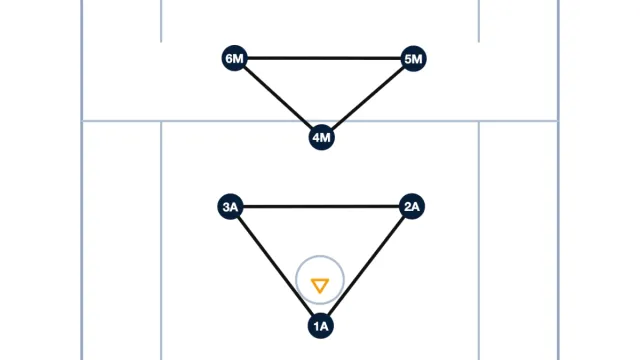
The 2-3-1 is one of the most recognizable offensive sets in men's lacrosse. Instructional resources commonly use it as a foundation for teaching movement, passing, dodging, and two-man actions.
The basic alignment features:
Two players toward the top
Three players through the middle
One player behind the cage
The arrangement naturally creates triangles that players can use for passing and cutting.
Why Run a 2-3-1?
The 2-3-1 provides a balanced structure for:
Dodging
Give-and-go actions
Picks
Ball movement
Crease feeds
Three-man combinations
It also gives coaches a useful framework for teaching off-ball movement.
One common problem is players becoming too attached to their positions. The goal is not to have a player permanently occupy one spot on the field.
Instead, players should understand when to cut, fill, replace, pick, or move the ball.
Coaching Cue
Teach the players the relationships between positions rather than memorizing locations.
If one player moves, another player should recognize the space being created and fill it.
2-2-2 Offense
The 2-2-2 creates a more balanced arrangement across the field.
A typical 2-2-2 alignment has:
Two players toward the top
Two players through the middle/crease area
Two players toward the bottom or behind the goal
The formation creates opportunities for players to attack from different areas while using the two inside players for picks and cuts.
The 2-2-2 is generally considered more complex than some basic formations because players may need to make longer passes across the formation and recognize multiple cutting and dodging opportunities.
Why Run a 2-2-2?
The formation can create opportunities for:
Corner dodges
Crease picks
Inside cuts
Two-man actions
Quick ball reversals
Attacking from multiple areas
Because there are players distributed around the field, the defense has to account for threats from several directions.
Coaching Cue
Spacing is everything.
If the players collapse toward the ball, the advantages of the formation disappear.
Teach players to maintain enough space that a dodge can create a legitimate slide and an open teammate can become a passing option.
Motion Offense
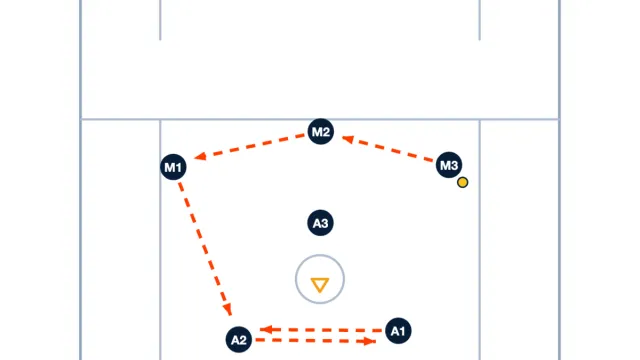
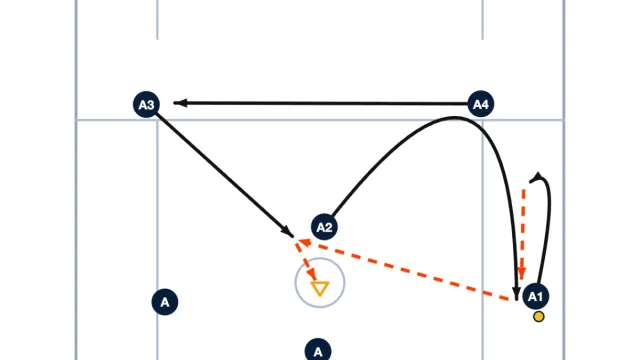
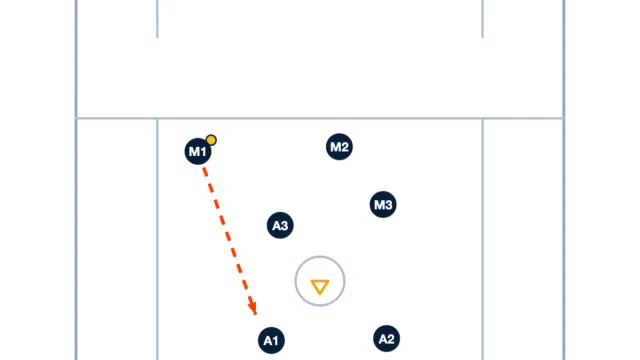
A motion offense is less about maintaining one specific formation and more about teaching players how to continuously react to the movement of the ball and their teammates.
Instead of calling a new play every time the ball moves, players follow principles that dictate when they should:
Cut
Pick
Roll
Replace
Clear through
Dodge
Feed
Move the ball
This makes the offense harder to predict because the defense cannot simply memorize where each player will be.
The concept of motion offense is also used as a progression in coaching education, where players learn to make movement automatic and use motion as an offensive tool.
The Key to Motion
Motion does not mean everyone runs around randomly.
Good motion has purpose.
A player cutting should create space for someone else. A player setting a pick should understand who is using it. A player clearing through should know where the next opportunity is developing.
The best motion offenses combine structure with player decision-making.
Discussion
Comments (0)
No comments yet.
Log in with an active subscription to comment.
Log in