
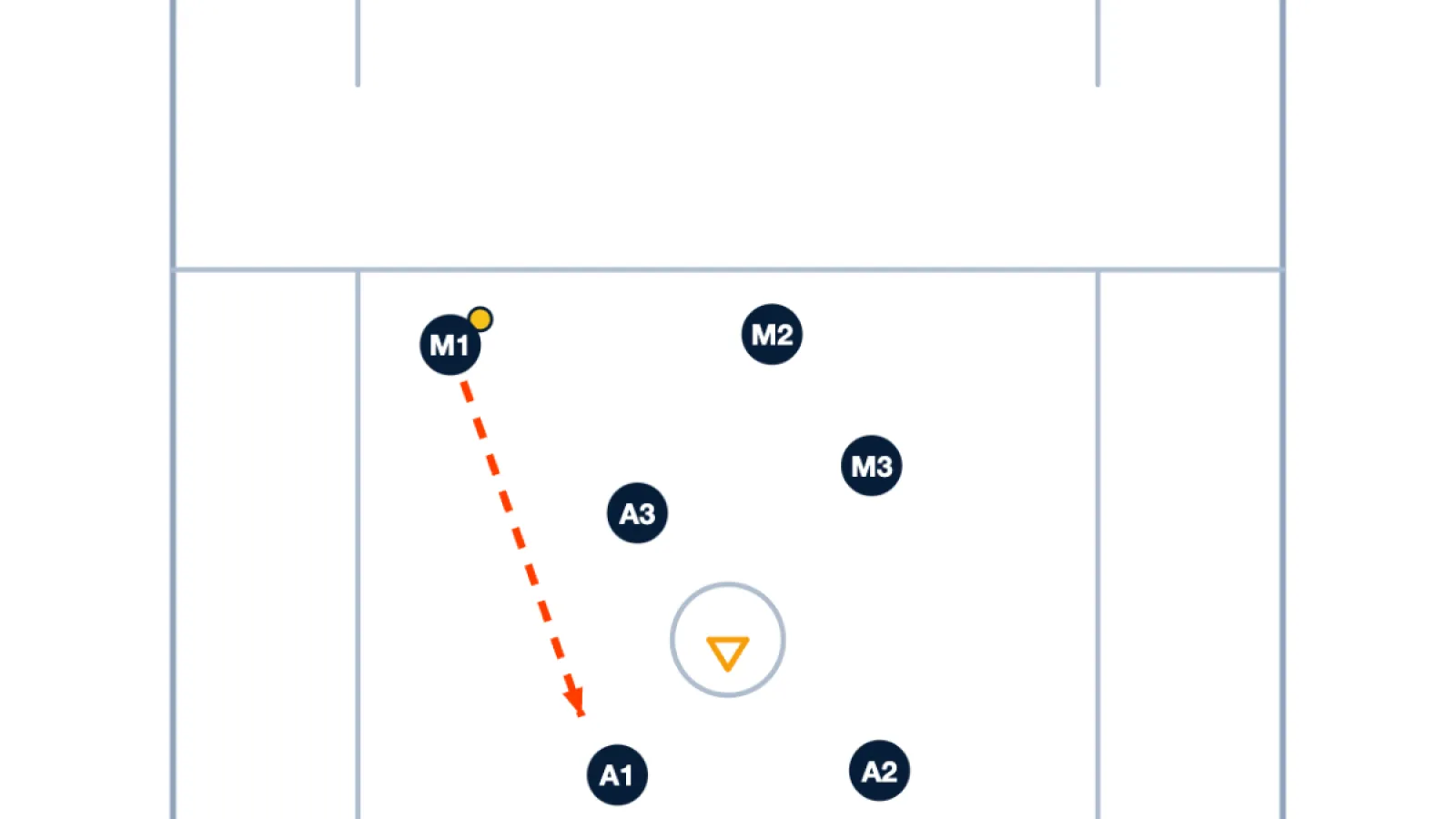
The 2-1-3 offense is built around the movement and versatility of the midfielders. The system keeps at least two midfielders up top, creates short passing options, and allows the three midfielders to use cuts and dodges to generate offense.

The basic principles of the offense are:

  • Keep at least two midfielders up top to help stop a fast break after a change of possession.

  • Minimize the length of passes between players.

  • Use the three midfielders to create cutting and dodging opportunities.

  • Allow the attackmen behind the cage to stay active while also giving them opportunities to rest.

The 2-1-3 is a basic set, but it can be expanded with different three-man actions and used from either side of the field.

Phase 1: Initiating the Offense

The first phase begins with M1 swinging the ball to A1, who then passes to A2.

As A2 is about to receive the ball, the midfielders begin moving:

  • A3 back-picks for M1.

  • M1 cuts off A3's pick toward A2.

  • M2 moves above the restraining line, anticipating the next phase.

The movement creates an opportunity for M1 while also positioning M2 to become involved if the first option isn't available.

Phase 2: M1 Is Not Open

If M1 isn't open after the initial action, A2 has two options.

Option 1: Move the Ball Through the Midfield

2-1-3 Offense (3)

A2 passes to M3, who then passes to M2.

M2 has repositioned approximately 3–5 yards above the restraining line. This positioning helps maintain a player up top while also putting M2 in a good position to dodge down the left side.

M2 catches the ball with his shoulders square to the cage and immediately dodges to his left.

As M2 initiates the dodge:

  • M3 replaces M2.

  • M1 replaces M3.

M2 can now dodge and shoot or use the movement to initiate Phase 1 again.

This continuous rotation keeps the midfielders moving and maintains the structure of the offense.

Option 2: Reverse the Ball

A2 can also reverse the ball back to A1.

When this happens:

  • M1 and A3 pick for M3.

  • M3 cuts toward A1.

  • M1 replaces M3.

This balances the set and creates another opportunity for M3.

If M3 isn't open for a shot, the team can work the ball around the perimeter and restart the set from either side.

This allows the offense to preserve its personnel while continuing to look for an opening.

Adding Three-Man Actions

The 2-1-3 doesn't have to remain limited to the basic progression.

Coaches can add three-man actions from the same formation.

For example, M2 passes right to M3, then M2 sets a pick for M1. M1 cuts toward the right midfielder and looks for a right-handed shot.

These actions take advantage of the three midfielders' ability to pass, cut, pick, and dodge within the formation.

Running the Set From Either Side

The phases, options, and three-man actions can all be used on either side of the field.

The important part is maintaining the basic structure while allowing the midfielders to create movement through cuts and dodges.

The 2-1-3 provides a simple framework, but the movement within that framework gives the offense multiple ways to attack.