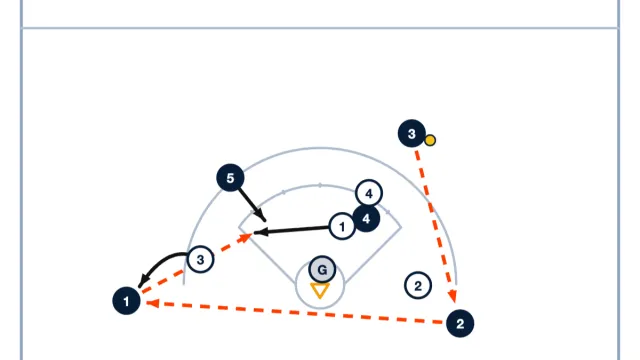
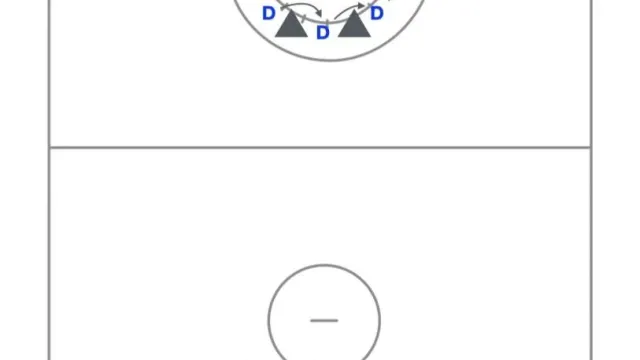
The International Backer Zone is a defensive system that gives players specific situations to defend and clear responsibilities to work on.
Instead of allowing the offense to score in any way, start with simple constraints. This lets the defense focus on the details that matter most: 1v1 defense, help defense, defending cutters, communication, and reacting to the drive-to-feed game.
What the Defense Is Working On
The Backer Zone focuses on three main situations.
1. Defending the Drive
The offense can only score on drives.
This puts the focus on your individual 1v1 defense while making sure the help defense is ready and aware.
Defenders need to be sound in their individual matchups while understanding when and where help is available.
The goal is to make the initial drive difficult without losing awareness of what is happening around them.
2. Defending the Feed
The offense can only score off feeds.
Now the defense has to focus on what happens away from the ball.
Defenders should:
Step up on cutters
Communicate with teammates
Pass players off
Stay aware of cutters moving through the defense
This helps players learn to defend the passing game instead of simply following their individual matchup.
3. Defending the Drive-to-Feed
The final progression is the drive-to-feed.
The offense must first look to drive. From there, they can look to dump the ball off on a feed.
This forces the defense to defend both parts of the action:
First, stop the drive. Then, react to the feed.
Players have to communicate and recognize what is happening as the play develops.
Build Into the Backer Zone
Once the defense has worked through these individual situations, build the drill into a full 6v6.
Add the backer and allow the defense to work through the same concepts in a more complete setting.
The backer becomes an important part of the defensive structure, helping the defense respond as the offense attacks and moves the ball.
The backer zone also gives coaches flexibility in how much pressure they want the defense to apply. Because the backer stays in the middle, coaches can choose when, where, and how hard they want the defense to pressure the ball.
Add Offensive Constraints
You can continue adjusting the drill based on what your defense needs.
Start by taking away skip passes.
This gives the defense a simpler situation to read and allows players to focus on the initial drive, the help, and the feed.
Once the defense is comfortable, allow skip passes.
Now players have to cover more space and react to additional passing options.
The progression can be:
No skip passes → Add skip passes → Full 6v6
Why Use Constraints?
The constraints give your defense something specific to work on instead of asking players to defend everything at once.
If you want to improve 1v1 defense, make the offense score only on drives.
If you want to work on defending cutters, make feeds the only way the offense can score.
If you want to combine those skills, use the drive-to-feed constraint.
Then, once players understand the concepts, put them together in the full Backer Zone.
Communication Is Key
The Backer Zone requires players to stay connected and communicate as the ball moves.
Defenders need to know where the ball is, where the cutters are going, and when they need to pass a player off.
The backer also has to remain aware of the developing play and adjust with the defense.
The source emphasizes that the backer zone is a team defense, rather than simply having one player responsible for covering everything.
Progression for Practice
Use the following progression to introduce the Backer Zone:
1. Start with drives
Work on 1v1 defense and help.
2. Add feeds
Focus on cutters, communication, and passing players off.
3. Add the drive-to-feed
Make the defense defend both actions in sequence.
4. Add the backer
Move into the Backer Zone structure.
5. Go 6v6
Allow the defense to apply the concepts in a game-like situation.
6. Add skip passes
Increase the difficulty once the defense is ready.
The goal is to gradually build the defense rather than throwing the entire system at players at once.
Coaching Point
The most important part of the Backer Zone is giving your defense specific problems to solve.
Start simple. Make the offense earn its scoring opportunities through drives, feeds, or drive-to-feed actions. Then gradually remove the constraints and let your players handle more realistic offensive movement.
As the defense becomes more comfortable, you can adjust the constraints to match exactly what your team needs to improve.
Discussion
Comments (0)
No comments yet.
Log in with an active subscription to comment.
Log in