
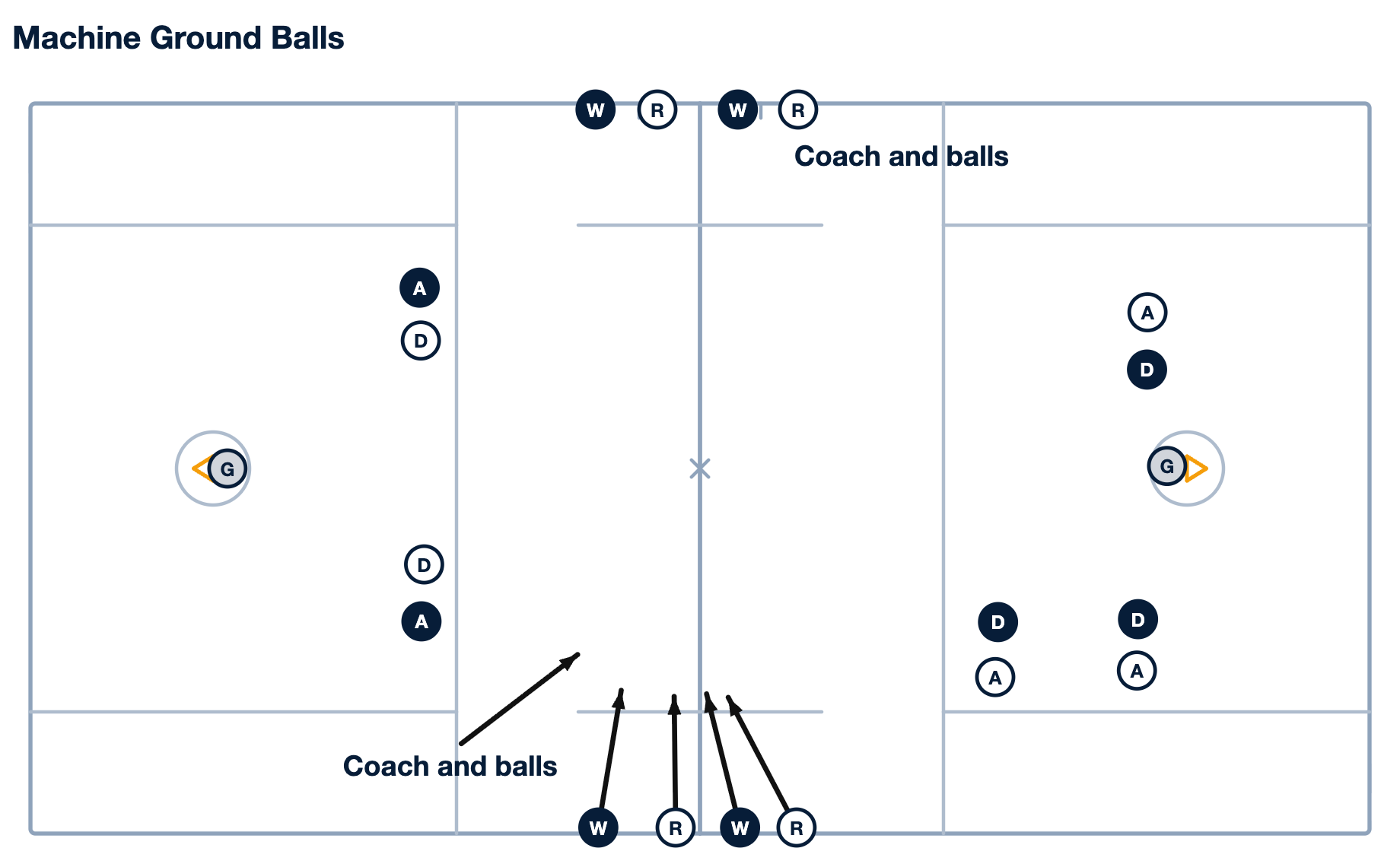
This drill combines several important parts of lacrosse into one continuous activity. Players compete for a ground ball, transition immediately into offense, and then play full-field 5v5.
The added scramble element means the drill doesn't necessarily stop after a shot, turnover, or missed opportunity. Players have to react to what happens next and continue playing.
That makes it useful for developing ground balls, transition awareness, conditioning, and competitive play.
Setup
Set up a full field with a goal and goalie at each end.
At each end, have:
3 attackmen
3 defensive poles
1 goalie
At midfield, create four player lines:
Two lines wearing one color
Two lines wearing another color
Four players begin at midfield and battle for the initial ground ball.
The team that wins possession immediately transitions toward its offensive end.
Start With a Ground Ball
The drill begins with a 2v2 ground ball battle at midfield.
Once one team gains possession, the players immediately transition upfield.
The result is often a 5v4 transition opportunity with a trailer, creating a realistic situation where players have to recognize numbers and attack quickly.
The emphasis should be on playing rather than waiting for the next whistle.
Let the Scramble Continue
One of the biggest differences in this version of the drill is that the coach allows the play to continue.
If a player wins the ground ball and takes a quick shot, the coach can immediately roll another ball into play with the same players on the field.
If a shot goes wide, another ball can be added.
Players must react to the new ball and continue competing.
The drill can continue until a goal is scored.
Clearing and Going Full Field
If the defense gets a stop or wins a ground ball, they clear the ball and go all the way down the field.
The drill then becomes full-field 5v5.
The attack and defense players remain on the field rather than immediately returning to midfield for a new repetition.
This is where the conditioning component becomes significant.
Players may be on the field for several minutes, constantly transitioning between offense and defense.
The goal is essentially to earn your way off the field by scoring.
Everyone Competes for Ground Balls
Another important part of the drill is that players don't necessarily stay restricted to their traditional positions during the ground-ball battle.
Attackmen, midfielders, and defensive players can all compete for possession.
A player carrying a defensive pole might win the ground ball and become the transition ball carrier.
This reinforces the idea of developing players as lacrosse players first, rather than limiting them strictly to their listed position.
Adjusting for Different Rosters
For a group of approximately 20–25 players, you can use four players in a midfield box on one sideline.
If you have a larger group, such as two teams practicing together, place four players in boxes on both sides of the field and alternate which side begins the drill.
For younger or less experienced players, move the goals approximately 15 yards closer to shorten the field.
If you have more than six attackmen and defensive players, rotate groups regularly so players get opportunities to compete and recover.
Conditioning Through Competition
The drill's conditioning comes naturally from the continuous play.
Players are sprinting into transition, recovering on defense, clearing the ball, and attacking again without frequent breaks.
Even two or three minutes of continuous full-field play can become demanding.
That is what makes the drill valuable. Players aren't simply running conditioning sprints. They're conditioning while making decisions and playing actual lacrosse.

Discussion
Comments (0)
No comments yet.
Log in with an active subscription to comment.
Log in