
Lacrosse is a fast, physical sport, so understanding fouls and penalties is essential for players, coaches and parents. A foul can change possession, create a scoring opportunity or put a player in the penalty area, but the way fouls are called and enforced depends on the version of lacrosse being played.
Men’s, women’s and youth lacrosse do not use identical penalty systems. Men’s field lacrosse primarily separates violations into personal and technical fouls, while women’s lacrosse uses major and minor fouls, free positions and cards. Youth rules add further age-specific modifications designed around player development and safety.
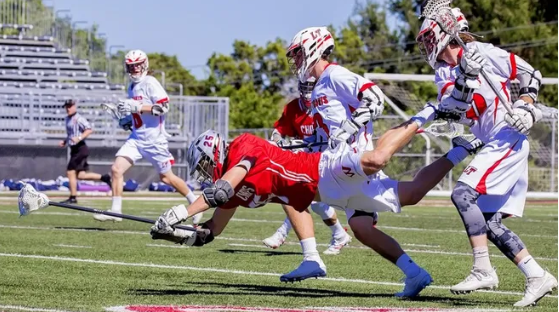
Men’s Lacrosse Fouls
In men’s lacrosse, fouls are generally divided into personal fouls and technical fouls.
Personal Fouls
Personal fouls are more serious violations and can result in penalty time. Common examples include:
Slashing: Illegal stick contact with an opponent.
Cross-checking: Using the portion of the stick between the hands to make illegal contact.
Unnecessary roughness: Excessive or unnecessary physical contact.
Illegal body checks: Illegal checks, including certain contact to the head or neck.
Unsportsmanlike conduct: Conduct that violates standards of sportsmanship.
The exact penalty depends on the foul and the applicable ruleset. Penalty time should therefore not be treated as one universal number across youth, high school and college lacrosse.
For 2026 high school boys’ lacrosse, USA Lacrosse and NFHS have placed particular emphasis on properly worn equipment, personal fouls involving contact to the head or neck, sportsmanship and pregame responsibilities.
Technical Fouls
Technical fouls are generally less severe than personal fouls and can result in a change of possession or penalty time, depending on the situation.
Common examples include:
Holding
Interference
Pushing
Illegal procedure
Offside
Warding off
Importantly, not every action that looks like holding or pushing is automatically illegal. For example, the 2026 boys’ youth rules specifically describe circumstances in which holding can be legal, including certain equal-pressure situations against a ball carrier or an opponent within three yards of a loose ball.
Women’s Lacrosse Fouls
Women’s lacrosse uses a different foul and penalty structure.
Rather than simply using the men's personal-versus-technical classification, women's lacrosse uses major and minor fouls, along with cards for certain violations. A foul can result in a free position, with the location and administration depending on the foul and where it occurred.
Some important women's lacrosse concepts include:
Shooting Space
Defenders cannot illegally position themselves in the path between an attacking player and the goal in a way that creates an unsafe shooting situation.
Three Seconds
In the 8-meter arc, a defender generally cannot remain there for more than three seconds unless she is closely marking an opponent.
Charging and Forcing Through
Offensive players can also commit fouls. A player cannot simply force her crosse through defenders to create an advantage. USA Lacrosse specifically highlighted forcing through as an area of emphasis for 2026 youth girls' lacrosse.
Cards
Women's lacrosse uses cards to address certain fouls and misconduct. The exact card and penalty depend on the ruleset.
For example, the 2026 USA Lacrosse women's rules comparison identifies different card and penalty structures across youth, high school, NCAA/WCLA and other versions of the game.
NCAA women's lacrosse also changed its penalty structure for the 2025-26 season, including expanded one-minute releasable penalties and dangerous-contact penalties becoming non-releasable yellow cards.
Youth Lacrosse Penalties
Youth lacrosse deserves its own section because youth rules are not simply scaled-down versions of adult rules.
USA Lacrosse publishes separate youth rulebooks for boys and girls ages 14U and below, with age-appropriate modifications intended to support player development and safety.
For boys' youth lacrosse, rules can vary by age group, including modifications to checking and penalty enforcement. For example, USA Lacrosse's 2026 youth materials include specific rules for 8U and 10U play.
Girls' youth lacrosse also includes age-specific rules. At the 12U level, for example, modified checking is permitted under specific conditions, including a downward-and-away movement below the shoulder.
Because of these differences, players and parents should always check the rulebook used by their particular league or age division.
What Happens After a Foul?
The result of a foul depends on which ruleset is being used, the type of foul, where it occurred and whether the situation is live or dead ball.
Possible consequences include:
Change of possession
Free position
Penalty time
Releasable or non-releasable penalty
Yellow or red card
Player ejection or disqualification in serious situations
In women's lacrosse, a free position is a major part of penalty administration. For example, a major defensive foul inside the 8-meter area can result in an offensive free position from an 8-meter hash.
Common Lacrosse Fouls at a Glance
Type | Common Examples | Typical Result |
|---|---|---|
Men's personal foul | Slashing, cross-checking, illegal body check | Penalty time |
Men's technical foul | Holding, interference, pushing, offside | Possession change or penalty time |
Women's major foul | Dangerous contact, shooting-space-related violations | Free position or card, depending on ruleset |
Women's minor foul | Procedural or less serious violations | Free position or other administration |
Youth foul | Age-specific violations | Varies by age and ruleset |
Do not use this table to determine the exact penalty for a specific game. Penalty administration varies by league, age group and governing body.
How Players Can Avoid Penalties
The best way to reduce penalties is to understand what your ruleset allows and control your technique.
1. Play the body legally
Men's players should understand where and how body contact is permitted. Women's players need to understand the specific contact and checking restrictions of their level.
2. Control your stick
Avoid reckless swings, uncontrolled checks and contact outside the permitted areas.
3. Know the field rules
Offside, the crease, restraining lines, the 8-meter area and other field restrictions can create different violations depending on the version of lacrosse.
4. Keep your equipment legal
Illegal equipment can result in penalties. In 2026 boys' high school lacrosse, USA Lacrosse and NFHS specifically emphasized properly wearing required equipment.
5. Know your league's rulebook
This may be the most important one. A rule that applies in NCAA lacrosse may not apply the same way in youth lacrosse.
2026 Rule Changes to Know
Lacrosse rules continue to evolve, particularly around safety and game administration.
For boys' high school lacrosse, 2026 points of emphasis include equipment, head and neck contact, sportsmanship and pregame responsibilities.
For girls' high school and youth lacrosse, 2026 points of emphasis include managing fouls during scoring plays, delay of game, treatment of officials and proper defensive positioning.
At the NCAA women's level, additional penalty-structure changes are being considered for the 2026-27 academic year. These are proposals and should not be presented as current rules until officially approved.
Final Takeaway
Lacrosse penalties are designed to keep the game fair, competitive and safe, but there is no single penalty system that applies to every version of lacrosse.
Men's lacrosse uses personal and technical fouls. Women's lacrosse relies on major and minor fouls, free positions and cards. Youth lacrosse adds age-specific modifications to make the game appropriate for developing players.
If you're learning the game, don't just memorize a list of fouls. Learn which ruleset your league follows, what constitutes legal contact, and how penalties are administered at your level.
Always check your current league, USA Lacrosse, NFHS or NCAA rulebook for the exact rule governing your game. USA Lacrosse maintains separate official resources for boys' and men's and girls' and women's lacrosse.
Discussion
Comments (0)
No comments yet.
Log in with an active subscription to comment.
Log in