
The crease is one of the most important areas around the lacrosse goal.
It protects the goalkeeper, creates space for defensive play and places important restrictions on offensive players. Understanding the crease is especially important for attackers looking to finish around the cage and defenders trying to protect their goalie.
The basic concept is simple: the crease is protected space around the goal, but the exact rules governing it depend on the level and ruleset being played.
For the 2026 boys' high school season, the NFHS also introduced an important change involving defensive players entering their own crease to act as an emergency goalkeeper.
What Is the Crease?
The crease is the marked area surrounding the lacrosse goal.
In boys' and men's field lacrosse, it serves as a protected area for the goalkeeper and creates restrictions on how offensive and defensive players can interact with the goal area.
The crease is not simply a place where players cannot step. The rules governing it depend on who is entering, what they are doing, whether they have possession and what is happening with the ball.
For that reason, players should learn the crease rules as part of the larger goal-area rules rather than treating the crease as an automatic no-entry zone for everyone except the goalie.
Why Does the Crease Exist?
The crease serves several purposes.
Protecting the Goalie
The goalkeeper needs space to track shots, move around the cage and make saves without offensive players crowding the goal.
Protecting Scoring Opportunities
Crease restrictions prevent attackers from gaining an unfair advantage by positioning themselves illegally around the goal.
Creating Defensive Structure
The crease also gives defenders a defined area to protect when the offense attacks the cage.
For players, this means crease awareness can affect everything from dodging and shooting to sliding and recovering.
Can Offensive Players Enter the Crease?
In boys' lacrosse, offensive players cannot enter the crease.
This is one of the most important rules for attackers to understand.
An attacker who steps into the crease can cause play to be stopped or a goal to be disallowed, depending on the circumstances.
The important part is timing. A player crashing toward the goal needs to control their feet and body position so they can attack the cage without entering the restricted area.
What About the Stick?
An offensive player can reach their stick into the crease to play a loose ball under the applicable rules, but there are restrictions. USA Lacrosse's 2026 officiating materials specify that an offensive player may reach a stick into the crease to collect a loose ball but cannot make contact with the goalkeeper or the goalkeeper's crosse.
This is why players need to understand the difference between entering the crease with their body and legally playing a ball near the crease with their stick.
Crease Violations on Shots
One of the most common situations occurs when an attacker shoots while moving toward the crease.
For example:
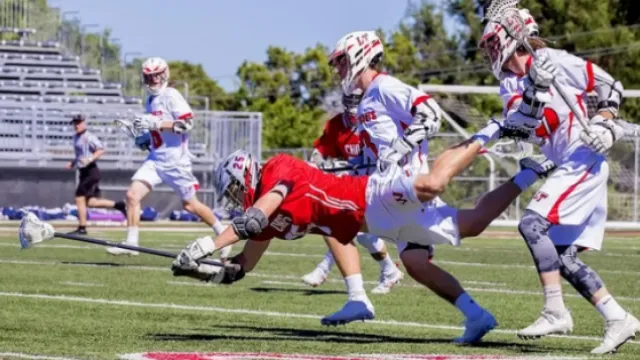
An attacker dodges from the wing, shoots while falling and lands inside the crease.
If the player had not established the required legal position before the scoring action, the goal can be disallowed under the applicable rules.
The 2026 NFHS boys' rules specifically clarify that a goal is disallowed if a player jumps without possession, catches a pass, shoots and lands in the crease.
For attackers, the lesson is simple:
Know where your feet are before you shoot.
What About Defensive Players?
Defensive players have more flexibility around the crease than offensive players, but there are still important restrictions.
A defender may enter or pass through the crease in certain circumstances. However, there is a major limitation:
A defensive player cannot enter their own crease with the perceived intent of blocking a shot or acting as a goalkeeper unless they are the properly equipped goalkeeper.
This became particularly important in 2026.
The 2026 Boys' High School Crease Rule Change
Beginning with the 2026 high school boys' lacrosse season, the NFHS changed the penalty for a defensive player who enters his team's crease with the perceived intent of blocking a shot or acting as a goalkeeper.
Previously, this situation was handled differently. Under the new rule, it is classified as a personal foul for illegal equipment and is administered as a non-releasable penalty.
The purpose is player safety.
A regular field player does not have the same protective equipment as a properly equipped goalkeeper. The rule discourages defenders from putting themselves directly in front of shots to protect an empty net.
USA Lacrosse's 2026 officiating materials describe the penalty as a one-minute non-releasable foul for illegal equipment.
Example
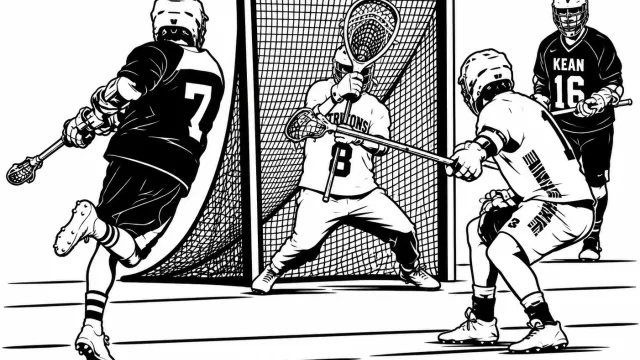
The goalie is out of position and an attacker has a clear shot at an open goal.
A defender runs into the crease and positions himself in front of the cage to act as a substitute goalie.
Under the 2026 boys' high school rule, that can result in the non-releasable illegal-equipment penalty.
The better defensive response is to prevent the shot from happening in the first place through communication, slides and recovery.
Can the Goalie Leave the Crease?
Yes.
A goalkeeper can leave the crease and participate in live play. Once outside the crease during live play, the goalkeeper is treated as a field player.
This is why you will often see goalies run out to scoop ground balls or help initiate a clear.
However, there is an important 2026 change involving what happens after a restart.
The 2026 Goalie Reset Change
Under the old NFHS boys' rule, a goalkeeper could receive up to five seconds to return to the crease after certain restarts.
That five-second allowance was eliminated for 2026.
The NFHS explains that the change treats the goalkeeper more like a field player when dealing with injury or equipment issues while outside the crease.
USA Lacrosse also notes that the change eliminates the need for officials to determine whether a goalie left the crease for a legitimate purpose or to delay the game.
Important: This specific change is not automatically identical across every level of lacrosse. USA Lacrosse's 2026 youth rules note that the five-second change applies to 12U and 14U at the youth level.
Common Crease Violation Examples
Here are some situations players should recognize.
1. Attacker Steps Into the Crease
An attacker cuts toward the cage and steps inside the crease before finishing the play.
Result: The play can be stopped and the goal may be disallowed.
2. Attacker Lands in the Crease
An attacker jumps, catches a pass, shoots and lands in the crease.
Result: Under the 2026 NFHS boys' rules, the goal is disallowed.
3. Attacker Interferes With the Goalie
An offensive player makes contact with the goalkeeper or interferes with the goalkeeper's ability to make a play.
Result: A crease-related or other applicable foul may be called depending on the circumstances.
4. Defender Acts as an Emergency Goalie
A defender without goalkeeper equipment enters his own crease to intentionally block a shot.
Result: Under the 2026 NFHS boys' rules, this is a personal foul for illegal equipment and is non-releasable.
5. Goalie Leaves the Crease
The goalkeeper runs outside the crease to retrieve a ground ball.
Result: During live play, the goalie is treated as a field player outside the crease.
How Attackers Can Avoid Crease Violations
Good crease awareness starts with body control.
Watch your feet. Don't let momentum carry you through the crease after a dodge.
Know where the cage is. Attackers should develop spatial awareness so they know how close they are to the crease without having to look down.
Control your landing. Jumping and finishing around the cage requires awareness of where you'll land.
Give yourself space. You don't need to run directly through the crease to attack the goal.
How Defenders Should Play Around the Crease
Defenders should understand the difference between protecting the crease and entering it illegally.
Communication is critical.
Instead of relying on a field player to become an emergency goalie, the defense should use slides, recoveries and communication to prevent clean shots.
The 2026 rule change makes this even more important for high school boys' teams.
Does the Crease Rule Apply the Same Way Everywhere?
No.
This is one of the biggest things to remember when learning lacrosse rules.
Men's, boys' youth, high school, collegiate and women's lacrosse can have different rules governing the crease and goal area.
USA Lacrosse maintains separate rules resources for boys' youth, boys' high school and men's lacrosse, while NFHS publishes the official high school boys' rules and interpretations.
So if you're coaching a 10U team, playing high school lacrosse or watching an NCAA game, don't assume that a rule from one level automatically applies to another.
Final Takeaway
The crease is one of the most important areas on a lacrosse field.
For attackers, it creates a boundary that requires awareness, timing and body control. For goalies, it provides protected space to defend the cage. For defenders, it is an area they must understand without relying on illegal emergency-goalie tactics.
The 2026 NFHS boys' high school rules added an important safety-focused change: a defensive player who enters his own crease with the perceived intent of blocking a shot or acting as a goalkeeper can receive a non-releasable personal foul for illegal equipment. The five-second goalkeeper return allowance on restarts was also eliminated under the NFHS boys' rules.
The best way to play around the crease is still the simplest: know the rules, communicate early and control your position.
Discussion
Comments (0)
No comments yet.
Log in with an active subscription to comment.
Log in