
3-1-3 Clear
The 3-1-3 clear is a standard clearing formation in men’s lacrosse. It gives the team with possession multiple passing options while spreading players across the field.
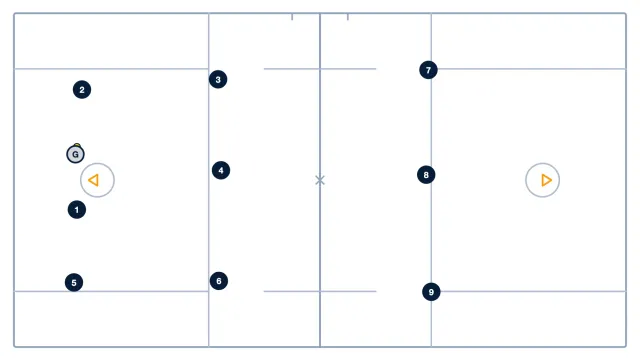
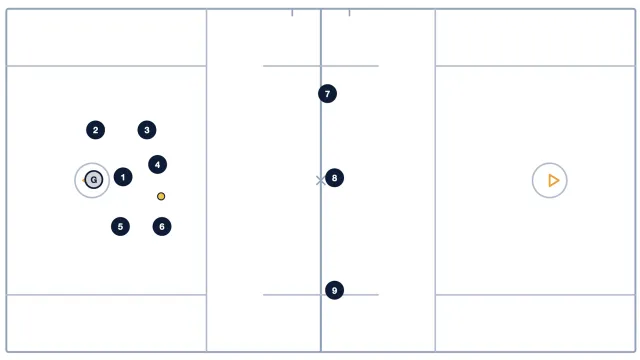
The formation uses three players near the defensive end, one player in the middle, and three players farther upfield.
How the 3-1-3 Clear Is Set Up
The basic formation is:
3 players near the defensive end
1 player in the middle
3 players upfield
The three players at the defensive end consist of the goalie and two defensemen.
The middle player is typically a midfielder who acts as a floater or hunter, providing a passing option between the defensive and midfield areas.
The three players upfield consist of two midfielders and one defenseman.
This creates a seven-player clearing unit: the goalie plus six field players.
The Three Players at the Defensive End
When the clear begins, the goalie and two defensemen provide the initial outlets.
The two base defensemen can move along the goal line extended while the third defenseman moves upfield.
This movement gives the goalie passing options while helping spread the riding defense.
The ball carrier should look for an open teammate rather than forcing a pass into pressure.
The Middle Player
The single player in the middle is an important part of the formation.
Often referred to as the floater or hunter, this midfielder provides an additional passing option between the defensive players and the players farther upfield.
The middle player can receive a pass and continue advancing the ball or move the ball to another open player.
The Three Upfield Players
The three players farther upfield provide options toward midfield.
In the standard setup, one midfielder moves toward the center of the midline, another moves toward the substitution-box side, and the third player moves toward the center of the restraining line.
Their positioning gives the ball carrier multiple options as the clear develops.
Reading the Ride
The 3-1-3 is a formation, so the exact pass depends on how the riding team positions its players.
The goalie or ball carrier should identify the available outlet and move the ball to the open player.
If an upfield player is open, the ball can be advanced quickly. If those options are covered, the ball can be worked through the middle player or back to one of the defensive outlets.
The goal is to use the formation to create passing options rather than forcing one predetermined pass.
Coaching Points
When teaching the 3-1-3 clear, emphasize:
1. Maintain spacing.
Players need to occupy their areas so the clearing team has usable passing lanes.
2. Give the ball carrier options.
The formation is designed to provide multiple outlets.
3. Move the ball when pressure arrives.
The clearing team can use passes to advance the ball as the ride shifts.
4. Read the defense.
The correct pass depends on which clearing option the ride takes away.
5. Avoid forcing passes.
If an option is covered, use another outlet within the formation.
Why Use a 3-1-3?
The 3-1-3 gives a team a structured way to organize its seven players during a clear.
It places players at different levels of the field and provides multiple passing options against a riding defense.
The important part is not memorizing one sequence of passes. Players need to understand their positioning and recognize which teammate is open as the ride develops.
The 3-1-3 gives your clearing unit structure, spacing, and multiple outlets to advance the ball.
Discussion
Comments (0)
No comments yet.
Log in with an active subscription to comment.
Log in