
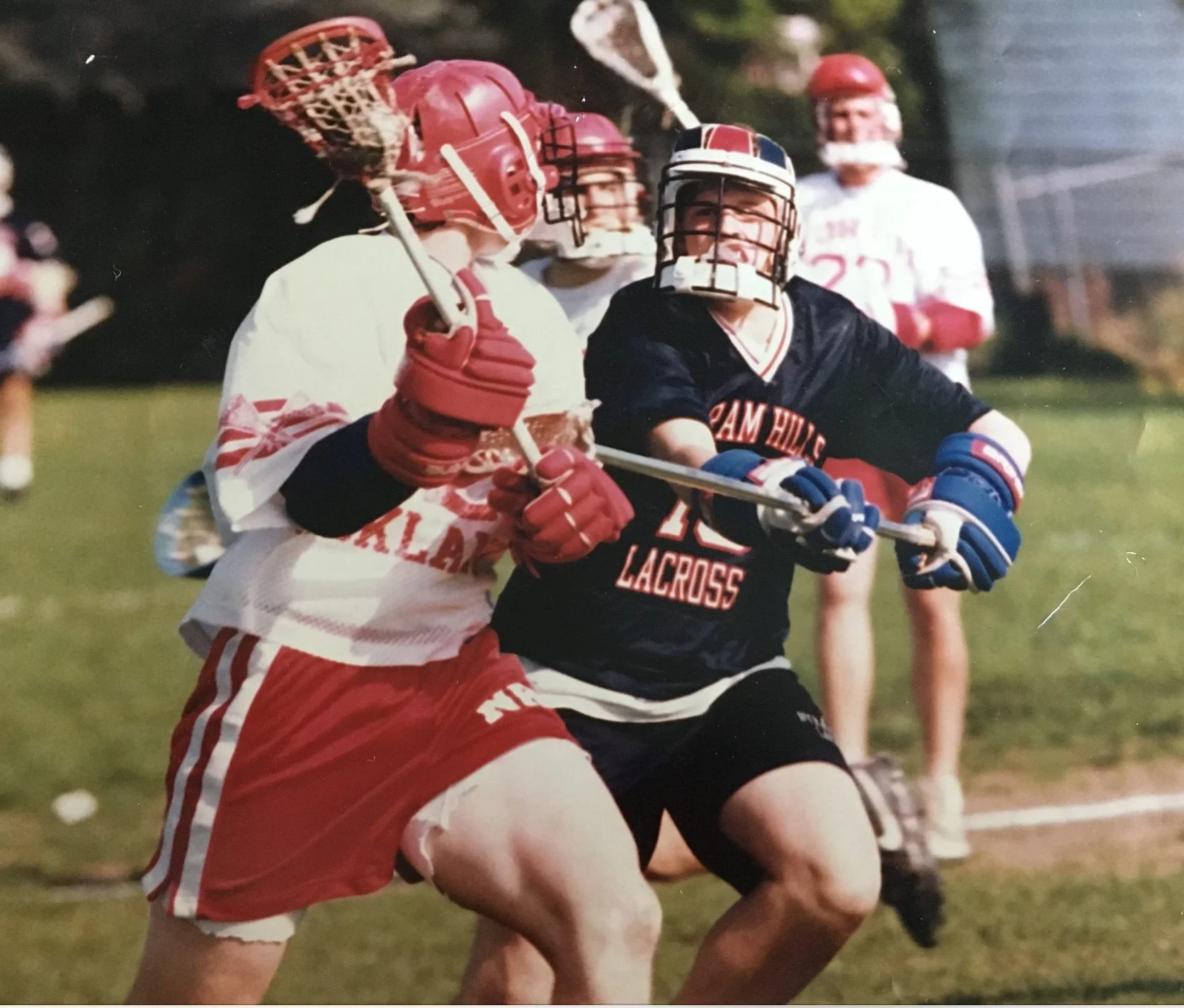
Team defense becomes much easier when every defender knows where the next slide is coming from.
The adjacent slide package gives defenders a clear system for helping the ball carrier while continuing to protect the rest of the field.
Understanding Adjacent
In lacrosse, adjacent simply means next to.
In a three-on-three setup, defender A is guarding the ball carrier, player 1. Defenders B and F are guarding the players immediately next to the ball.
These are the adjacent defenders.
The defenders communicate their responsibilities with simple calls:
"Ball" for the defender guarding the ball
"Right" for the adjacent defender on the right
"Left" for the adjacent defender on the left
The purpose of these calls is simple. If the ball carrier beats defender A, the adjacent defender on that side is ready to slide.
The First Slide
The first slide comes from the defender directly adjacent to the side where the ball carrier gets through.
For example, if the ball carrier beats defender A toward the left, defender F calls "left" and becomes the first slide.
If the ball carrier beats A toward the right, defender B calls "right" and slides.
The call tells everyone which defender is responsible for helping.
The Second Slide
The defense also needs to prepare for the next pass.
Behind the first-slide defenders are potential second slides:
B has the first slide on the right, while C has the second slide on the right.
F has the first slide on the left, while E has the second slide on the left.
The communication becomes:
"Right, two right."
or
"Left, two left."
If the first slide is beaten or the ball moves again, the second slide is ready to step in.
The Third Slide
Now add defender D to the opposite side of the formation.
D becomes the three slide.
Because D is on the complete opposite side, he is responsible for the third slide in this setup.
The complete communication can sound like:
"Ball. Right. Left. Two left. Two right. Three."
Everyone should know their responsibility before the slide happens.
One Fluid Movement
The slide package should not happen as a series of disconnected movements.
It should happen as one fluid defensive movement.
The ball defender gets beaten.
The first slide comes.
The second slide adjusts.
The third slide moves into position.
Everyone communicates and shifts together.
The goal is to stop the ball while still protecting the next open offensive player.
Recovery Slide
Every slide creates an opening somewhere else.
When defender D slides across to cover offensive player six, offensive player four can become open.
That's where the recovery slide comes in.
The original ball defender needs to recognize the open space and recover into it.
After getting beaten, defender A should quickly move toward the middle of the paint and find the open offensive player.
Don't automatically drop all the way to the bottom of GLE.
Instead, find a good position in front of the goal where you can see the player you're recovering to and remain ready for another pass.
The Complete Adjacent Slide Package
Think of the sequence like this:
1. Ball: Defender A communicates that he has the ball.
2. First Slide: The adjacent defender on the side of the dodge slides.
3. Second Slide: The next defender on that side prepares to help.
4. Third Slide: The defender on the opposite side becomes the three slide.
5. Recovery: The defender who was beaten fills the open space.
Key Takeaways
Adjacent means next to the ball defender.
Communicate your slide responsibility before the dodge happens.
The adjacent defender becomes the first slide.
The next defender becomes the second slide.
The defender on the opposite side becomes the third slide.
Everyone should move together rather than reacting individually.
The defender who gets beaten must recover and fill the open space.
Protect the middle of the paint during recovery.
Discussion
Comments (0)
No comments yet.
Log in with an active subscription to comment.
Log in