
Picks and crossing cuts are built to confuse two defenders at once. If the two defenders aren't on the same page, one attacker gets free. The fix is to agree ahead of time on how you'll play it.
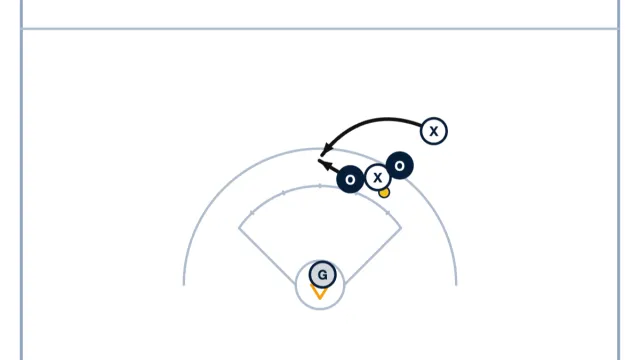
Here are three options, all shown against the same offensive action: two attackers near the 8-meter crossing paths, with one setting a pick for the other.
Option 1: Stay with your matchup
Each defender sticks with her own attacker no matter what. When the pick comes, the defender being picked fights through it, going over the top or sliding under, and stays with her player.
Best when: Your defenders are quick and the matchups are good. Staying avoids mismatches.
Risk: If the defender gets caught on the pick, her player is open for a moment, and the slip or roll may be open too.
Option 2: Switch based on who cuts first
The defenders trade players based on timing. Whichever attacker cuts first gets picked up by the defender closest to her path, and the other defender takes the second cutter.
Best when: The offense runs a lot of quick crossing cuts. Switching keeps defenders from running into each other.
Risk: Switching takes clear, early talk. A late or quiet switch leaves both defenders on the same player.
Option 3: Take whoever comes out on your side
Each defender owns a side, left or right. When the attackers cross, each defender takes the player who comes out on her side, no matter who it is.
Best when: The action happens in a tight space, like inside the 8-meter. It's simple, and it keeps defenders from crossing paths themselves.
Risk: The offense can create mismatches, like a quick attacker ending up on a slower defender.
Diagram note
Use the same starting picture in all three diagrams: two attackers, two defenders, and the same pick or crossing cut. Only the defenders' arrows change. Label each diagram Stay, Switch on First Cutter, or Take Your Side.
Communication is everything
Whichever option you choose, the two defenders have to talk early:
"Pick left!" The off-ball defender warns her teammate before the pick arrives.
"Stay!" or "Switch!" One clear call decides it. Many teams let the defender who can see the play best, usually the one guarding the picker, make the call.
"I've got her!" Each defender confirms her new player.
The call must come before contact, not after.
Common mistakes
Two defenders, one attacker. Both defenders follow the same player and leave the other wide open. This usually comes from no call or a late call.
Switching without calling it. One defender switches and the other doesn't know.
Running into the pick blind. The defender being picked needs her teammate's warning to fight through it.
Always switching. If the offense sees you switch every time, they'll use the pick to create mismatches. Mix it up.
Practice ideas
2v2 pick drill. Two attackers run the same pick or cross over and over. The coach calls the defensive option before each rep: stay, switch, or side.
Free choice. Once players know all three, let the defenders decide and call it themselves. Review on film which choices worked.
Quick checklist
Your team has chosen how it plays picks and crossing cuts, or when to use each option.
The off-ball defender warns of the pick before it arrives.
One clear call decides stay or switch.
Each defender confirms her player after the action.
Discussion
Comments (0)
No comments yet.
Log in with an active subscription to comment.
Log in