
A slide often turns into a double team. The beaten defender catches up, the slider is already there, and now two defenders are on the ball. That's a good thing, but only for a moment. Somewhere on the field, an attacker is open.
The question every double team has to answer quickly is: stay or go?
When to keep the double
Keep both defenders on the ball when the double is more likely to win the ball than the open attacker is to score.
The ball carrier is pinned at a poor angle, like near the sideline, near the restraining line, or below goal line extended with her back to the field.
Her stick is exposed or she's lost control of her cradle. A turnover may be one more second away.
She can't see the field. If her head is down or she's turned away, she can't find the open player.
The open attacker is far from the cage, so a pass to her isn't an immediate scoring threat.
When one defender should peel off
One defender leaves the double and recovers when the open attacker becomes the bigger threat.
The ball carrier is looking up and can see the open player.
A cutter is breaking into the 8-meter toward an open spot.
An outlet is wide open and close, giving the ball carrier an easy escape pass.
The ball carrier has room to turn toward the middle or the cage.
Who peels off?
Agree on this ahead of time. A common rule is that the defender closest to the open attacker leaves. Often that's the original slider, because she came from that area. The other defender stays on the ball. Whoever leaves should call it: "I'm off!"
Diagram note
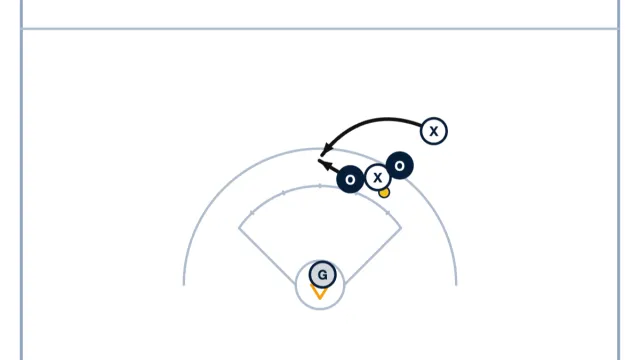
Draw two versions of the same double team. In the first, the ball carrier is pinned near the sideline with her back to the field, so both defenders stay. In the second, a cutter breaks into the 8-meter and one defender peels off to meet her. Shade the open attacker in each.
Doubling legally
Double teams are part of the women's game, but they still have to be clean. Both defenders need legal stick and body position, no holding, pushing, or reckless checks. At youth levels where checking is limited or not allowed, a double is about body position and taking away space, not about winning the ball with the stick. Check your league's rules for what's allowed at each age.
Common mistakes
Doubling forever. The double stays on too long and the open attacker gets an easy goal.
Both defenders leave. A miscommunication sends both off the ball, and the ball carrier walks in.
Peeling off to the wrong player. The defender who leaves should go to the most dangerous open attacker, usually the one closest to the cage.
Fouling out of frustration. When the double doesn't win the ball fast, defenders start reaching or pushing. That gives the offense a free position.
Practice ideas
2v1 trap plus outlet. Two defenders trap one ball carrier near the sideline. An outlet attacker moves around nearby. The defenders have to decide when to stay and when one leaves.
Coach's signal. During a scrimmage, the coach raises a hand when a double should break. Players learn the timing before they read it themselves.
Quick checklist
Keep the double when the ball carrier is pinned or can't see the field.
Peel off when an outlet or cutter becomes the bigger threat.
The closest defender to the open attacker leaves and calls it.
Doubles stay clean, with no holding or reckless checks.
Discussion
Comments (0)
No comments yet.
Log in with an active subscription to comment.
Log in