
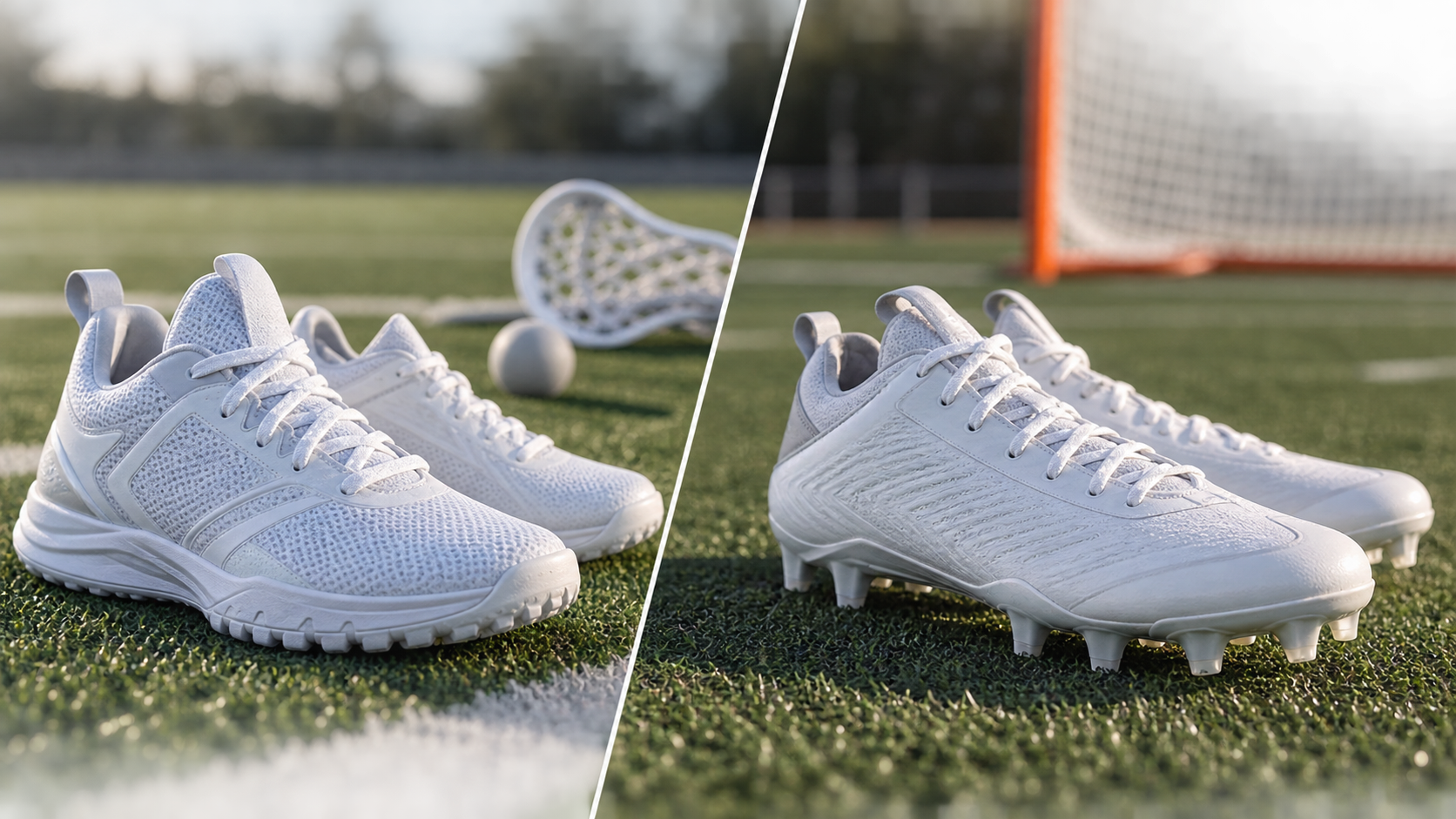
Choosing the right lacrosse footwear starts with one simple question: What surface are you playing on?
Cleats are designed to provide traction on natural grass, while turf shoes are built for artificial surfaces where traditional cleats may not provide the same feel or traction.
The right choice can affect how confidently you accelerate, change direction, cut, and stop during a game or practice.
Here’s how to choose between lacrosse turf shoes and cleats based on the surface you play on.
Lacrosse Cleats vs. Turf Shoes
The biggest difference is the outsole.
Lacrosse cleats use molded studs or spikes that dig into natural grass to provide traction.
Turf shoes use a flatter rubber outsole with many small traction elements designed to grip artificial turf.
Neither option is automatically right for every situation. The playing surface should determine your choice.
When Should You Wear Lacrosse Cleats?
Cleats are generally the better option for natural grass fields.
Natural grass can vary significantly depending on weather, field condition, and maintenance. A field may be firm and dry one day and soft or muddy the next.
Cleats provide additional traction by allowing the studs to engage with the grass and soil beneath the player's feet.
Cleats are useful for:
Natural grass games
Grass practices
Wet or soft grass
Quick acceleration
Cutting and changing direction
Defensive footwork
Midfield transition
For lacrosse players who spend most of their time on natural grass, a dedicated pair of lacrosse cleats is an important part of their equipment.
When Should You Wear Turf Shoes?
Turf shoes are designed specifically for artificial turf.
Instead of relying on longer studs that dig into the ground, turf footwear uses a lower-profile outsole with smaller traction elements.
This gives players a different feel under their feet and allows them to move across the relatively firm artificial surface.
Turf shoes can be useful for:
Artificial turf games
Turf practices
Indoor turf facilities
Training on synthetic surfaces
Quick lateral movements
Short, controlled cuts
If you regularly play on turf, having footwear designed for that surface can make more sense than using traditional grass cleats for every session.
Why You Shouldn't Treat Every Field the Same
Not all fields provide the same amount of traction.
A natural grass field may be dry and firm, while another could be wet and soft.
Artificial turf can also vary. Some turf fields have different generations of synthetic grass, infill materials, and surface characteristics.
That means the best footwear choice isn't simply about whether the field is called "grass" or "turf."
Consider the actual conditions.
Before practice or a game, think about:
What is the playing surface?
Is it wet or dry?
How firm is the surface?
Does the facility have footwear restrictions?
These factors can help determine which outsole will give you the appropriate traction.
Turf Shoes vs. Cleats for Speed
Both types of footwear are designed to help players move effectively on their intended surfaces.
The important consideration is traction without excessive interference from the surface.
On natural grass, cleats can help the player establish traction when accelerating and changing direction.
On artificial turf, turf shoes provide traction through their low-profile outsole without relying on long studs digging into the surface.
Your footwear should allow you to move confidently without feeling like your feet are slipping or catching unnecessarily.
What About Indoor Lacrosse?
Indoor facilities can have different playing surfaces, so don't assume that regular cleats are appropriate.
Many indoor lacrosse environments use artificial turf or other hard playing surfaces. Some facilities may have specific footwear requirements.
Before bringing your usual cleats to an indoor facility, check its rules.
If the facility specifies turf shoes or indoor footwear, follow those requirements.
Can You Wear Cleats on Turf?
This depends on the type of artificial turf and the facility's rules.
Some turf fields allow molded cleats, while others have restrictions on certain types of footwear.
Before playing, check the facility's footwear policy.
Even when cleats are permitted, the traction and feel can differ from what you experience on natural grass.
Can You Wear Turf Shoes on Grass?
You can physically wear turf shoes on some grass surfaces, but they may not provide the same traction as cleats.
Because turf shoes have a lower-profile outsole, they aren't designed to dig into natural grass in the same way molded cleats do.
On a firm, dry grass surface, you may find the traction acceptable for certain activities.
For competitive lacrosse on natural grass, however, players generally want footwear designed for that surface.
What About Wet Conditions?
Weather can change the footwear equation.
Wet natural grass can become slippery, making traction particularly important.
This is one situation where the outsole and stud configuration of your cleats matter.
Artificial turf doesn't respond to rain in exactly the same way as natural grass, and some facilities may have policies about playing in wet conditions.
Don't choose footwear based solely on the weather forecast. Consider the actual surface and the facility's rules.
How to Choose Your Lacrosse Footwear
Use the playing surface as your starting point.
Natural Grass
Look for:
Lacrosse cleats
They are designed to provide traction by engaging with the grass and underlying surface.
Artificial Turf
Look for:
Turf shoes
Their low-profile traction pattern is designed for synthetic surfaces.
Indoor Facility
Check:
The facility's footwear requirements
Some indoor facilities have specific rules, so always confirm before you arrive.
What About Women's and Men's Lacrosse?
The basic footwear principle is the same for both men's and women's lacrosse.
The surface should be the primary consideration.
Players in either game need footwear that supports acceleration, deceleration, lateral movement, and changes of direction.
The differences between footwear models are more likely to involve fit, construction, weight, support, and personal preference than whether the player participates in men's or women's lacrosse.
Should You Own Both?
If you regularly play on both grass and turf, having both options can be useful.
For example:
Grass game → Cleats
Turf game → Turf shoes
Grass practice → Cleats
Turf practice → Turf shoes
This also means you don't have to rely on one outsole for every playing environment.
If you only play on one type of surface, you can focus on finding footwear specifically suited to that surface.
Other Things to Consider When Buying Lacrosse Shoes
Surface is the first consideration, but it isn't the only one.
Fit
Your foot should feel secure without being uncomfortably compressed.
A shoe that is too loose can make cutting and acceleration feel less controlled.
Weight
Lighter footwear can feel responsive, but players should also consider support and durability.
Ankle Support
Some players prefer a lower-cut shoe for freedom of movement, while others prefer additional coverage around the ankle.
Your position and personal preference can influence this choice.
Traction Pattern
Look at how the outsole is designed for the surface you play on.
The goal is reliable traction without sacrificing natural movement.
Durability
If you're practicing several times per week, your footwear will experience significant wear.
Consider how frequently you'll use the shoes and where you'll use them.
The Bottom Line
Choosing between lacrosse turf shoes and cleats comes down primarily to the surface you're playing on.
For natural grass, lacrosse cleats provide the traction players need to accelerate, cut, and change direction.
For artificial turf, turf shoes provide a lower-profile traction system designed for the surface.
And if you're playing indoors, always check the facility's footwear requirements before you arrive.
The best approach is simple:
Grass → Cleats
Turf → Turf Shoes
Indoor → Check the facility rules
Once you know the surface, you can focus on finding a pair that fits well, provides the traction you need, and feels comfortable throughout the game.
Discussion
Comments (0)
No comments yet.
Log in with an active subscription to comment.
Log in