
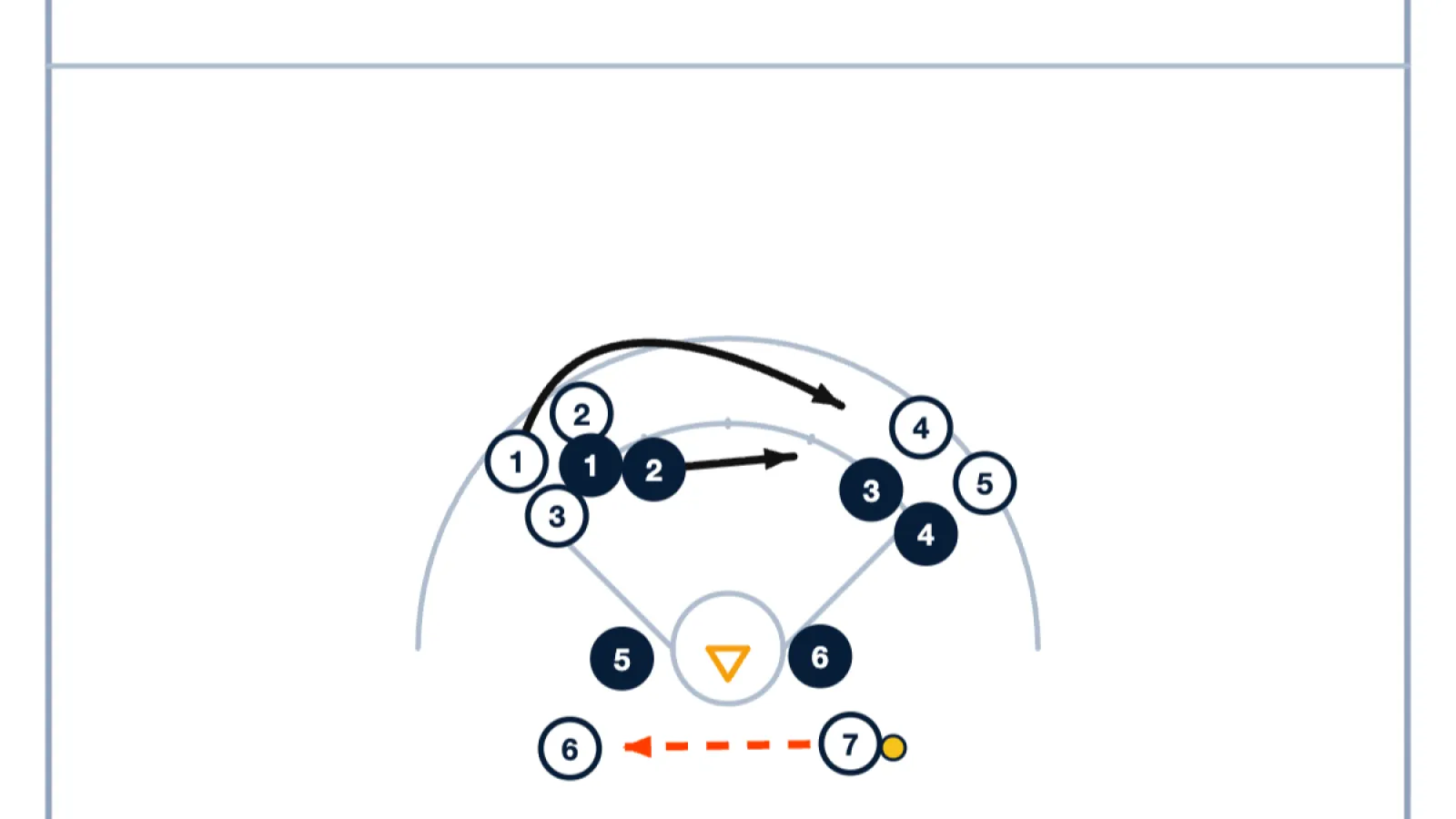
Pittsburgh is a scripted woman-up offensive play designed to make it easy for players to find a 2v1 or defensive imbalance. It is especially useful for younger teams that need something concrete and direct rather than relying entirely on free movement.
How It Works
The play uses two feeders behind the goal and players positioned around the elbows.
The exact side of the formation doesn't matter. What matters is identifying which side has the defensive imbalance.
The goal is to move the defense and create a brief 2v1.
1. Create the Imbalance
Start with three players on one side and two on the other.
One attacker cuts across, causing a defender to follow.
That movement creates the imbalance.
2. Move the Ball Quickly
Once the imbalance appears, kick the ball over immediately.
The player on the elbow holds her space while the other attacker cuts through to occupy the defender.
The ball then goes to the open elbow player.
The key rule is:
Over and in.
Move the ball over and then look inside.
3. Find the Shooting Space
The elbow player should hold her space, catch the ball, and look for the shooting opportunity.
This often creates an 8M shooting opportunity.
If the inside look isn't available, don't force it.
Reset the formation, create the imbalance again, and run it another time.
Don't Hold the Ball
The play works because the ball moves quickly.
If the player holds the ball for too long, the defense has time to recover.
The offense should not:
Pass → hold → wait → look inside.
Instead:
Create the imbalance → move it over → cut through → look in.
The first opportunity may not always be the best one. The defensive handoffs continue to happen as the ball moves, so another opportunity can appear after another cycle.
Keep the Middle Open
One important part of Pittsburgh is keeping the middle open.
The players around the elbows create space, while the cuts through the middle occupy defenders.
This makes it easier for the feeders to see the open player and find the 2v1.
Make an Adjustment
If the defense takes away one of the feeders, the play can be flipped.
Instead of feeding from behind the goal, the feeder can move to the top.
The same basic idea remains:
Drive → Find the imbalance → Cut through → Move the ball → Find the open player.
This gives the offense another option without completely changing the concept.
Why Use Pittsburgh?
This play is especially useful for a younger or developing team.
It gives players a clear job instead of asking them to figure out the entire woman-up possession on their own.
It also helps players learn how to recognize a 2v1, understand defensive handoffs, hold space, and move the ball quickly.
As players develop their lacrosse IQ, the play can become less scripted and give them more freedom to read the defense.
Discussion
Comments (0)
No comments yet.
Log in with an active subscription to comment.
Log in