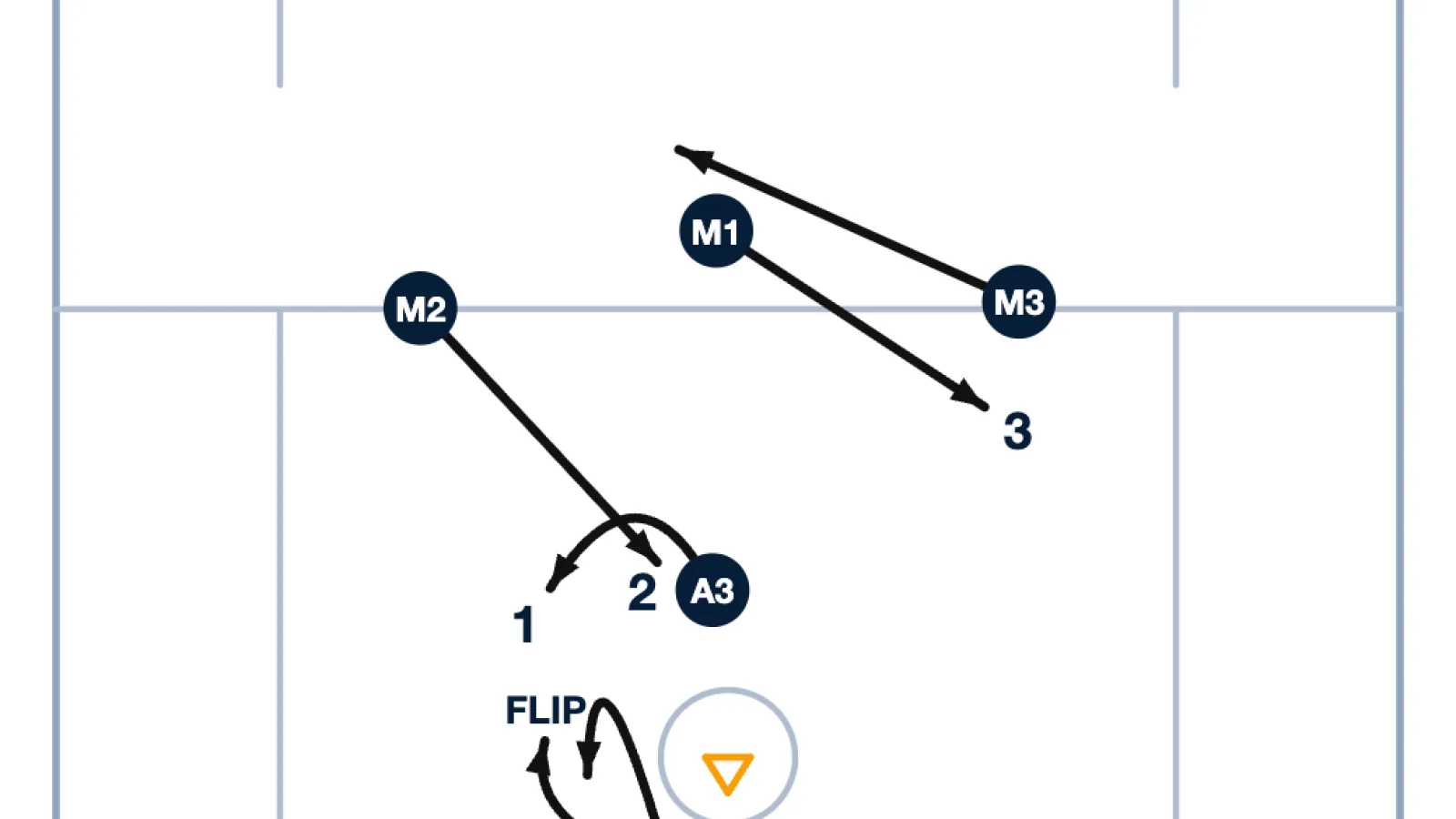
The North Star is a structured offensive play that starts from a 2-3-1 formation and uses coordinated movement to create several scoring options. The play relies heavily on timing, with the attackmen, crease player, and midfielders all moving together to put pressure on the defense.
It is particularly useful when a team needs a quick goal, such as at the end of a quarter or following an endline restart.
Starting Formation
The play begins in a 2-3-1 offensive formation, with the ball behind the goal on the back-left side with A2.
A2 initiates the action by dodging up the left side toward goal-line extended (GLE).
Once A2 reaches GLE, he turns and works his way back around the cage toward A1.
At the same time, A1 moves toward A2.
The Attack Exchange
As A2 approaches A1, the two attackmen meet near the cage.
A2 then uses an underhand flip to give the ball to A1, who cuts just outside of him.
A1 now has possession and begins working through the play's progression.
The timing of the exchange is important. A2's movement creates the initial action while A1 receives the ball in position to attack the defense.
First Look: A3 Off the Pick
The first option is the crease attackman, A3.
A3 comes off a pick from M2, the ball-side midfielder.
If A3 gets separation from his defender, A1 can feed him for a quick shot.
This should be the first look because the pick is designed to create an immediate scoring opportunity in the middle.
Second Look: M2 Slips Inside
If the defense takes away A3, the next option is M2.
After setting the pick, M2 slips inside toward the goal.
A1 can look for M2 as he cuts into the space created by the pick.
This gives the offense another quick inside scoring opportunity without requiring the ball carrier to force a shot.
Third Look: Skip Pass to M1
If neither inside option is available, A1 can make a skip pass across the field to M1.
M1 can then take a time-and-room shot or attack down the alley.
This third option keeps the defense from collapsing entirely toward the crease and gives the offense another way to attack.
The Top-Middie Switch
As the dodge develops, the two top midfielders, M1 and M3, switch positions.
This movement is important because it keeps their defenders occupied.
The goal is to prevent those defenders from simply leaving their assignments and helping against the inside feeds to A3 or M2.
The switch should happen as part of the overall timing of the play rather than as a separate movement.
Timing Is Critical
The North Star play depends on everyone moving at the right time.
A2's dodge, the movement toward A1, the underhand exchange, A3's pick, M2's slip, and the M1-M3 switch all need to work together.
If the movements happen too early or too late, the defense has more time to recognize the play and recover.
When to Use North Star
North Star can be especially effective when the offense needs a quick scoring opportunity.
Consider using it:
At the end of a quarter
Off an endline restart
When the team needs a quick goal
When the defense is unsettled
When you want to create an immediate inside scoring threat
The play gives the ball carrier three primary options while keeping the defense occupied with movement away from the ball.
Discussion
Comments (0)
No comments yet.
Log in with an active subscription to comment.
Log in