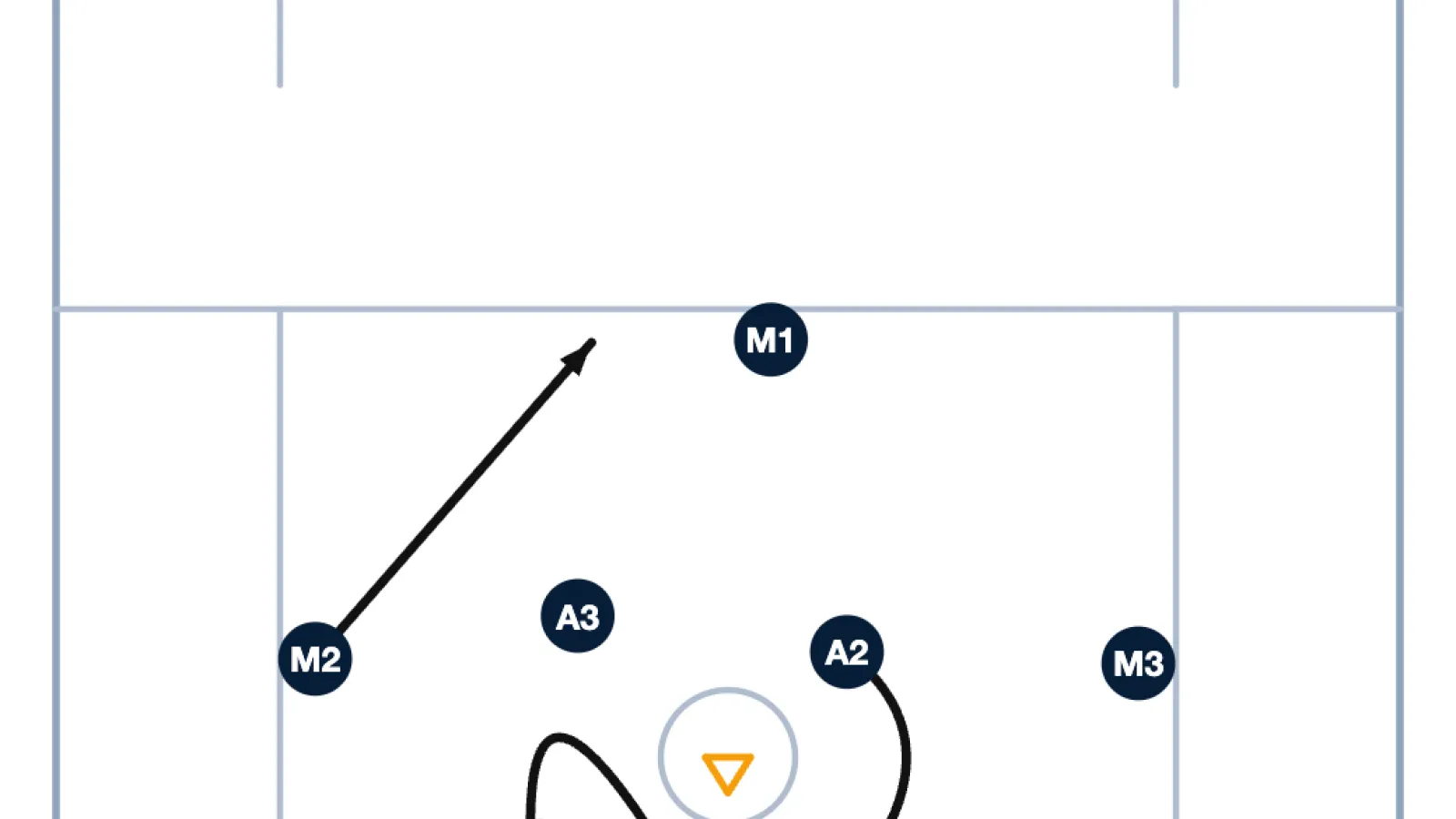
The 1-4-1 formation provides an effective structure for creating movement and opening passing lanes around the crease. The Roll Off Play uses the movement of the attackmen and midfielders to manipulate defenders before creating an inside feed.

The play can be used during extra-man offense (EMO) and can also be effective against a zone defense. Because the 1-4-1 creates different rotations and slide responsibilities, it can force defenders to adjust to movement they may not regularly see.

Phase 1: Start the Movement

The play begins with A1 attacking toward goal-line extended (GLE).

After reaching GLE, A1 rolls back, creating movement for the defense to react to.

At the same time, A2 rolls off the crease and moves below GLE.

The movement of A1 and A2 creates the initial rotation and begins opening space for the next action.

Meanwhile, A3 moves his defender.

A3 should move the defender high and in the opposite direction of where M1 will eventually cut. This helps create separation and makes it more difficult for the defender to recover to the cutting midfielder.

Phase 2: Create the Inside Opportunity

The next phase focuses on creating space for M1.

M3 seals the inside lane, occupying space in the middle and attempting to pick off the defender responsible for M1.

With the defense occupied, A1 passes the ball to A2, who has rolled off the crease and moved below GLE.

The timing of this pass is important because M1 is now preparing to cut.

M1's Cut

After A2 receives the pass, M1 cuts toward the ball.

M1 uses M3's seal to create separation from his defender.

The seal helps prevent M1's defender from taking a direct path to the cutter, giving M1 an opportunity to get open inside.

A2 should recognize the developing cut and look to feed M1.

The Finish

The final objective is an inside feed from A2 to M1.

If M1 gets enough separation, A2 can deliver the ball for the eventual shot.

The play therefore progresses from the initial A1 roll, through the A2 crease roll-off, and into M1's inside cut.

The success of the play depends on the players maintaining proper spacing and timing throughout both phases.

Why the Play Works

The Roll Off Play uses several movements at once:

  • A1 attacks and rolls back.

  • A2 rolls off the crease.

  • A3 moves his defender away from M1's cutting direction.

  • M3 occupies the inside lane and seals M1's defender.

  • M1 cuts toward the ball.

  • A2 looks for the inside feed.

These movements force the defense to react to multiple actions before the final feed develops.